
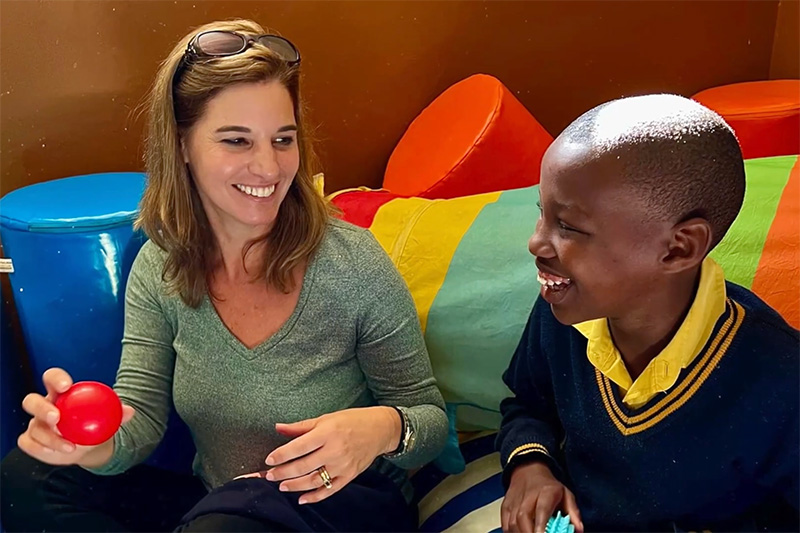
Experts with the Regional Gun Violence Research Consortium (RGVRC) address different facets of firearm violence from a variety of perspectives and disciplines. In this new series, get to know our experts and learn more about their contributions to better understand, prevent, and respond to the public health crisis of firearm violence. Get to know Amanda Nickerson, a member of the RGVRC, SUNY Distinguished Professor in the Graduate School of Education at the University at Buffalo, and Director of the Alberti Center for Bullying Abuse Prevention.
Why do you study gun violence? Why is this an important area of research, and how do you see your work helping to address this issue?
As a scholar dedicated to understanding positive youth development and well-being, I study gun violence because it is a critical and impactful issue. Gun violence has become one of the most significant threats to youth safety and mental health in the United States. Beyond those who are directly injured or killed by guns, exposure to violence affects families, schools, and entire communities and leads to increased risk for trauma, academic difficulties, and long-term emotional and behavioral problems.
My work seeks to move beyond describing the problem to understanding why youth gun violence occurs and how it can be prevented. Drawing on a social-ecological framework, I examine how individual factors (such as social-emotional development), family and peer dynamics (e.g., bullying victimization), school environments, and broader community conditions interact to increase or reduce risk. This approach recognizes that youth violence is not inevitable. Rather, it can be prevented through systems and experiences.
A central focus of my research is identifying protective factors that promote resilience. Many young people grow up in environments where they are exposed to multiple risks, yet they do not engage in violence. Understanding what differentiates these youth is critical. My work highlights the roles of supportive relationships, school connectedness, effective social-emotional skills, and equitable access to resources as key mechanisms that can buffer against violence. By elevating these protective pathways, my research contributes to strengths-based interventions rather than deficit-focused responses.
Equally important is my commitment to translating research into practice. I collaborate with schools, communities, and policymakers to ensure that findings inform real-world strategies. This includes developing and evaluating prevention programs, informing school climate initiatives, and contributing to effective school crisis and violence prevention and preparedness policies. Ultimately, my research is driven by a commitment to ensuring that all young people have the opportunity to grow up in safe, supportive environments. By advancing knowledge, informing interventions, and advocating for systemic change, my work contributes to a broader effort to reduce gun violence and promote youth well-being.
What is your research focus related to gun violence? What are you currently researching?
My research takes a comprehensive, prevention-oriented approach to reducing the risk factors and consequences of gun violence in schools. My contributions span school crisis prevention and intervention, bullying and peer victimization research, school shooting and targeted violence prevention, bystander intervention, and the study of school safety practices such as emergency operations plans and lockdown drills.
As an author, developer, and lead of the National Association of School Psychologists’ (NASP) PREPaRE model, I help schools build capacity for crisis prevention, preparedness, response, and recovery. PREPaRE emphasizes threat prevention, multidisciplinary planning, supportive school climates, early identification of students in distress, and effective responses to crises, all of which strengthen schools’ ability to prevent and mitigate acts of targeted violence, including gun violence. Our current work investigates how school crisis teams use information from this training to apply to their work in schools.
My research on bullying is highly relevant to gun violence prevention because experiences of chronic victimization, social rejection, and interpersonal conflict have been identified as risk factors in some cases of school-based targeted violence. My work has examined how positive school climates, strong student-adult relationships, and effective bullying prevention strategies can reduce aggression, improve student well-being, and foster school connectedness, which are protective factors associated with lower risks for violence. In addition, a recent study led by my doctoral student, Dylan Harrison, examined qualitative interviews with former extremists to identify push and pull factors that led them to leave extremist organizations, highlighting the importance of humanizing experiences with diverse individuals and social support.
I have also studied lockdown drills and school safety practices, along with consortium executive director Dr. Jaclyn Schildkraut. In this work, we have contributed to the evidence base regarding how schools can prepare for emergencies while minimizing unnecessary fear and psychological harm. This work helps schools balance readiness for rare but serious violent incidents with the broader goal of promoting student safety and well-being. We hope to continue this work on a national level to examine the impact of different types of drills and to contribute to best practice guidance.
A major focus of my research has been on teaching bystander intervention to students in an effort to prevent various forms of violence. By encouraging students to recognize warning signs, support peers, safely report concerns, and intervene in bullying and other harmful situations, this work strengthens a culture of collective responsibility and early intervention. Such approaches are important because peers are often aware of threats, conflicts, or warning behaviors before adults.
What do you hope that people can take away from the research you are conducting?
There are several takeaways from my research related to preventing gun violence and other forms of targeted violence in schools. First, prevention is most effective when it happens long before a crisis occurs. I have learned that creating positive, supportive, and connected school environments can reduce many of the risk factors associated with violence, including bullying, isolation, and unresolved conflict.
A second important implication of my work is that school staff, families, and communities all play a role in prevention. One consistent finding is that warning signs are often observed by peers before acts of violence occur. This means we should teach students how to recognize concerns, support one another, and safely report threats or troubling behavior. Bystander intervention is not only an important strategy for reducing bullying but also for preventing more serious forms of targeted violence.
Third, schools should focus on identifying and helping students who are struggling rather than relying exclusively on physical security measures. Effective prevention involves building trusting relationships, encouraging help-seeking, and using evidence-based approaches such as threat assessment and crisis prevention planning. The goal is to connect people with support before problems escalate.
My work with the NASP PREPaRE curriculum and lockdown drills has also shown that preparedness matters. Schools need plans, teams, and training to prevent, respond to, and recover from crises. However, preparedness should be balanced with attention to students’ emotional well-being. Research on lockdown drills suggests that schools should prepare for emergencies in ways that maximize safety while minimizing unnecessary fear and stress.
Perhaps the most important takeaway is that preventing gun violence is a shared responsibility and a continuous process. There is rarely a single cause or a single solution. Instead, prevention requires creating safe and caring school communities, addressing bullying and other forms of victimization, supporting mental health, encouraging reporting of concerns, and responding early when warning signs emerge.
Ultimately, I hope people take away that school safety is not only about preventing tragedy, but it is also about fostering environments where all students feel connected, respected, supported, and empowered to help one another. Those conditions not only reduce the risk of violence but also promote healthy development, learning, and well-being.
Learn more about Amanda and her work for the Regional Gun Violence Research Consortium below.