
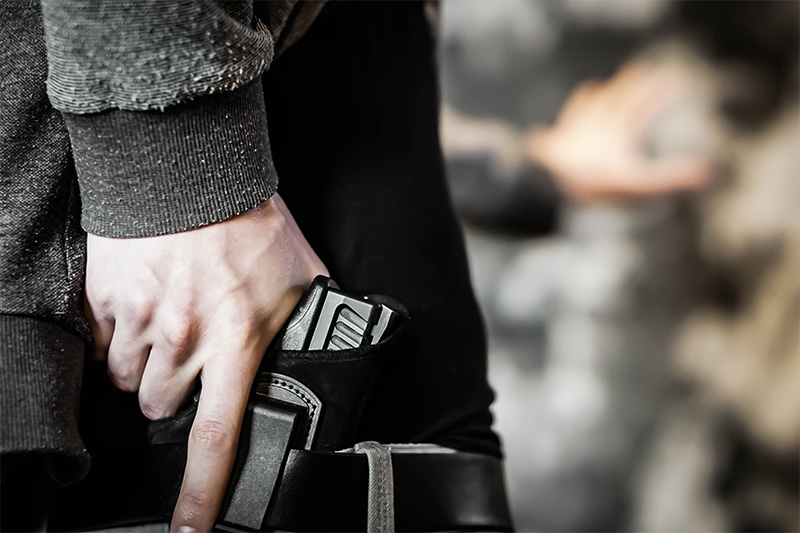
In the last decade, one of the most significant transformations in American gun policy has been the widespread adoption of permitless carry laws. Since 2013, 29 states have passed permitless carry laws, which allow gun owners to carry a concealed handgun in public without first obtaining a license or undergoing a background check. Permitless carry is now the most common form of concealed carry regulation in the United States.
To understand the impacts of permitless carry laws, it is useful to consider what exactly the laws change about public gun carrying. Before these laws, most states had in place “shall issue” concealed carry laws, which required gun owners to apply for a concealed carry license, pass a background check, and, in many cases, complete firearm safety training. Permitless carry eliminates these requirements, allowing any legal gun owner to carry a concealed weapon in public.
Rigorous research on the public safety impacts of permitless carry policies has, however, lagged behind its rapid adoption. Proponents argue that removing barriers to carrying in public places deters crime by increasing the costs of an altercation. Opponents argue that putting more guns in public spaces will result in more conflict and increased violence. For law enforcement, permitless carry laws present an enforcement challenge. Without a permitting system, it becomes more difficult for officers to distinguish legal from illegal gun carrying. Many police officials have expressed opposition to these laws’ continued adoption.
What the Research Finds
Prior research on the effects of concealed carry laws has largely considered permitless carry together with existing “shall issue” laws, treating them as a single policy type. This literature has generally found that more permissive concealed carry laws increase violent crime. But this approach has limited relevance to what is now the most prevalent form of concealed carry law. A smaller body of work has examined permitless carry laws more directly and, thus far, has found null or mixed effects on crime. However, these studies have focused on early adopting states and single states, or have relied on annual measures, which may not be well-suited to detect short-term policy impacts. Rightfully, other researchers have been concerned that it may be too early to reliably estimate the effects of permitless carry laws.
In July 2026, I published a study in the Journal of Policy Analysis and Management examining the effects of permitless carry laws adopted in eleven states between 2015 and 2019.1 Using monthly crime data from thousands of police agencies across the country and a study design that compared agencies in states that adopted permitless carry to those that did not, I estimated the effects of permitless carry laws on crime in the year following the law’s passage.
States with Permitless Carry Laws Adopted 2015 – 2019
In the 12 months after adoption:
e.g., burglary or theft
I found that permitless carry laws increase violent crime by about 7 percent in the 12 months after adoption. Firearm assaults specifically increased by approximately 12 percent, with no significant change in assaults committed with other, non-firearm weapons. The rise in firearm assaults occurred in public places, with an increase of about 15 percent, and victims were more likely to have sustained injuries from these conflicts. Conversely, permitless carry laws were not found to have had an impact on property crimes such as burglary or theft.
Importantly, firearm assaults began to increase in the months after the permitless carry law passed, before the law officially took effect. This anticipatory response is consistent with other firearm policy contexts, where gun owners respond quickly to laws or perceived changes in firearm regulation. Taken together, these findings suggest that, at least in the short term, existing gun owners respond to permitless carry laws by increasing the frequency of gun carrying. This finding is backed by national survey data. Between 2015 and 2019, gun owners who reported carrying concealed weapons in public nearly doubled from approximately 9 to 16 million.
Police Enforcement of Gun Laws
Beyond the effects on crime, I found a large shift in police behavior. Weapons law violations, a crime category primarily made up of concealed carry violations, declined by about 14 percent in offenses and by more than 20 percent in arrests following permitless carry adoption.
This reduction reflects, at least in part, the difficulty law enforcement faces in identifying illegal gun carrying. Some of this decline may also mechanically reflect conduct that is no longer illegal under the new law. Officers across the country have reported difficulty determining whether a person is legally allowed to carry a concealed weapon without a permitting system. The reduction in enforcement may be temporary as agencies adapt and develop new procedures and may be mitigated in states with mandatory firearm disclosure or “duty to inform” laws.
Limitations and Future Work
This study has a number of limitations that future work should address. I focus on states that adopted permitless carry between 2015 and 2019, a group that includes places like Kansas, Maine, West Virginia, and Kentucky. These states tend to be less urban and have lower rates of gun violence than the national average. More than 10 additional states have adopted permitless carry since 2020, including Texas, Florida, and Ohio. These are larger states with different rates of underlying gun ownership and where the effects of permitless carry may be different.
The one-year study follow-up period also only captures short-term effects. The longer-term effects of permitless carry on crime and violence as well as a range of other outcomes including gun thefts, illicit firearms entering the market, and on police enforcement remain open questions.
Options for Policymakers
Several policy options remain available to reduce public gun violence even in permitless carry states. Many states already restrict where guns may be carried, making bars, stadiums, and other public venues off-limits to concealed weapons. Location restrictions are broadly supported in public opinion, among both gun owners and nonowners, and expanding them may be an option to limit public gun violence.
The increase in public gun carrying also likely means more firearms are being stored in vehicles. Gun owners may leave a weapon in their car for ready access or may transport it more often. Policies promoting safe storage during transit and in vehicles could reduce gun theft from vehicles, an outcome that has been shown to rise after permissive concealed laws are adopted. Finally, improving police ability to enforce gun laws by enabling them to verify whether a gun carrier is a prohibited possessor, such as by granting officers access to state databases of legal gun owners, could help keep firearms out of the hands of those legally barred from carrying them.
The rapid adoption of permitless carry laws is one of the most significant shifts in firearm policy in the United States. Emerging research finds that removing the requirement to obtain a license before carrying a concealed firearm in public increases gun violence, particularly firearm assaults occurring in public spaces. As more states adopt these laws, it is essential to evaluate their long-term impact to inform what policies and practices can reduce harm to public health and safety.
ABOUT THE AUTHOR(S)
Susan T. Parker is a RGVRC affiliate scholar and a research assistant professor in the Department of Emergency Medicine and Buehler Center for Health Economics and Policy at Northwestern University.
- The states with permitless carry laws are Idaho, Kansas, Kentucky, Maine, Missouri, Mississippi, North Dakota, New Hampshire, Oklahoma, South Dakota, and Wyoming. ↩︎