
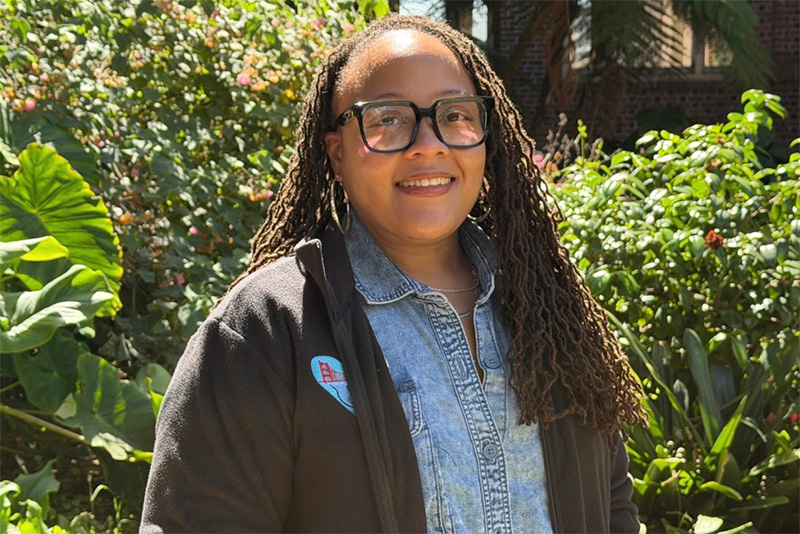
Experts with the Regional Gun Violence Research Consortium (RGVRC) address different facets of firearm violence from a variety of perspectives and disciplines. In this new series, get to know our experts and learn more about their contributions to better understand, prevent, and respond to the public health crisis of firearm violence. Get to know Nazsa Baker, an affiliate scholar with the RGVRC and Research Director and Program Manager of The Wraparound Project at Zuckerberg San Francisco General Hospital, University of California–San Francisco.
Why do you study gun violence? Why is this an important area of research, and how do you see your work helping to address this issue?
I study gun violence because I have never had the luxury of not knowing it. I grew up in East Orange, New Jersey, a city that knew gun violence intimately, and from the age of 13, Newark, New Jersey, a city that raised me professionally, deepened that understanding in ways I carry with me still. Not from a textbook or a dataset, but from living in it from a young girl to a woman. I watched the cities that raised me absorb loss after loss. It was personal long before it was professional. I lost high school classmates to community firearm violence, and then there was my cousin, who was shot in front of my grandmother’s house, the house where I grew up. The local news will tell you one story about communities like Newark and East Orange, but living there, working there, going to school there, and growing up there teaches you something entirely different. Gun violence does not live in a report or a headline. It lives in bodies, in families, and in the geography of your childhood. So, when it came time to pursue my doctoral research, doing it in a city that raised me was not a coincidence; it was a calling. I conducted my PhD dissertation at University Hospital’s Hospital-Based Violence Intervention Program (HVIP) in Newark, and that work brought everything full circle. Being inside an HVIP, understanding how it functioned, who it reached, and where it fell short, planted the seeds for every research question I am still chasing today. I study gun violence because survival is not the end of the story, and I refuse to neglect those stories.
What is your research focus related to gun violence? What are you currently researching?
My research focuses on Black men who survive firearm violence, specifically those living with firearm-acquired physical disabilities. At the center of my work is a question the field has largely avoided: what happens to the body after the bullet? I use qualitative methods as my primary approach to this work. One area of my research examines HVIPs, asking how these programs function, what outcomes they measure, and whether those outcomes capture what actually matters for survivors’ long-term health, safety, and wellbeing. My newest area of research centers on risk assessment within HVIPs. Using in-depth interviews with HVIP frontline workers and survivors, with a team, I examine how risk is defined, measured, and operationalized within these programs.
What do you hope that people can take away from the research you are conducting?
My deepest hope is that this research disrupts the intentional silence around Black men who have acquired disabilities through community firearm violence. Black men who survive firearm violence are more than the bullets that didn’t kill them; their recovery is a journey that is long, nonlinear, and largely invisible to the systems that should be supporting them. What happens to the body that absorbs a bullet, that is damaged and disfigured, and still expected to carry on? My research insists that survival is not the finish line. It is, in many ways, where the hardest part begins. I want people to understand that a firearm-acquired disability doesn’t arrive alone. It comes with lost wages, fractured relationships, a questioning of Black manhood and masculinities, and a system that was never designed to support Black men in healing. The disability is real. The neglect that follows is structural and intentional. And it is codified. The Americans with Disabilities Act was written as a promise of protection and inclusion but that promise was never fully extended to Black men whose disabilities were acquired through community violence. When the cause of disability is criminalized, the person becomes ineligible for sympathy and, too often, ineligible for protection. These men are disabled by a bullet and then disqualified by a narrative. I want clinicians to see their patients more fully. I want policymakers to stop treating violence as an event and start treating it as a condition that reshapes lives across time. I want other researchers to take seriously what happens after to follow people into their recovery, into their homes, into the parts of life that don’t show up in hospital discharge data. And most personally, I want the Black men at the center of this work to feel seen, heard, and felt. Not as statistics. But as people whose experiences carry knowledge that this field desperately needs, and whose healing matters as a matter of justice. This research is an argument that Black men’s bodies, futures, and lives are worth protecting and worth fighting for.
Learn more about Nazsa and her work for the Regional Gun Violence Research Consortium below.