
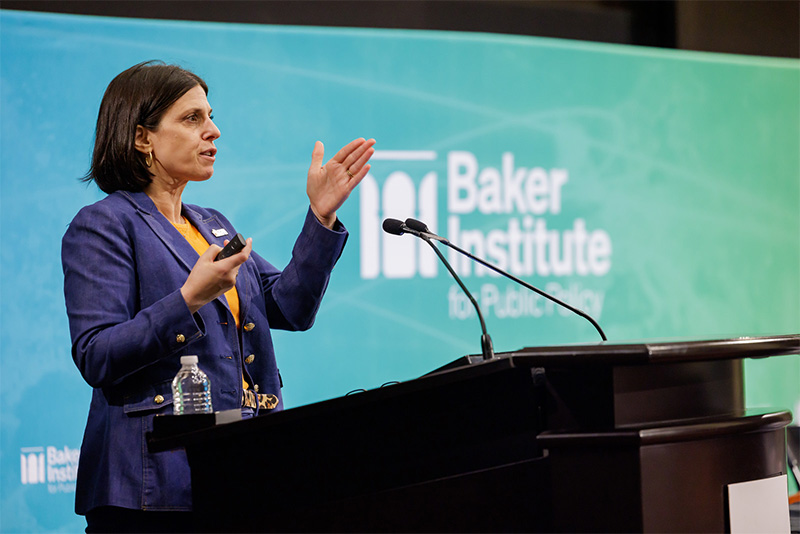
Experts with the Regional Gun Violence Research Consortium (RGVRC) address different facets of firearm violence from a variety of perspectives and disciplines. In this new series, get to know our experts and learn more about their contributions to better understand, prevent, and respond to the public health crisis of firearm violence. Get to know Jennifer Necci Dineen, a scholar with the RGVRC, associate professor in residence in the School of Public Policy at the University of Connecticut, and the interim director for the ARMS Center for Gun Injury Prevention.
Why do you study gun violence? Why is this an important area of research, and how do you see your work helping to address this issue?
I came to firearm policy through a commitment to ensuring that government decisions reflect the lived experiences of the people they affect—and the practitioners responsible for carrying them out. My early work in political science and school mental health policy taught me how often policymaking lacks formal mechanisms for incorporating user knowledge at the point of conceptualization. In 2012, as part of a project studying school-based mental health screening, I saw firsthand how stakeholder insights—from teachers and parents to district administrators—could identify practical barriers and opportunities that policymakers routinely overlooked. That experience shaped my entire approach to research. But what shifted my focus toward firearm injury prevention was watching, both personally and professionally, how well-intentioned the policy proposals that aimed to improve school safety after the shooting at Sandy Hook Elementary School were developed and deployed without meaningful input from those who understood schools and children best. The more I learned about firearm injury and death in the US, the clearer the need for user-informed, context-grounded research became. Today, I study firearm policy to help ensure that interventions and laws are not only evidence-based but also feasible, implementable, and aligned with the lived realities of those they aim to protect and those we depend on for implementation.
What is your research focus related to gun violence? What are you currently researching?
My research tackles gaps in current policies and interventions by looking closely at the factors that shape them and how they actually work in practice. At the heart of my work is a simple question: What do users and policy implementers see as the biggest challenges and the most promising solutions to those challenges? I approach these issues as both a survey methodologist and a policy scholar, working as part of multidisciplinary teams to ensure that research is grounded in real community experience. By bringing their knowledge, beliefs, and lived experiences into the policy process early, I aim to strengthen implementation and improve long-term adoption of evidence-based interventions.
In my firearm injury prevention research, I explore if and how physicians approach firearm safety counseling regarding secure storage both in and out of the home, and the factors that shape whether these conversations happen. This line of work highlights the essential role clinicians play as trusted messengers and their potential contribution to policy implementation. It also underscores the need for interventions that address system-level constraints.
I also examine how people, especially those who own and use firearms, think about firearm policies and practices. These perceptions are shaped not only by personal experience but also by practical concerns such as access, usability, family safety, and prior exposure to violence. My research highlights the importance of developing policies and interventions that are grounded in the real experiences, preferences, and constraints of the people they are intended to serve. Firearm owners regularly navigate tradeoffs between accessibility, cost, and feasibility, and these considerations shape whether interventions are adopted and sustained. Barriers often arise when recommended strategies do not align with users’ needs, expectations, or household realities, for example, when storage options feel incompatible, impractical, or difficult to access. By centering the perspectives of those most affected by a policy, I hope to contribute to the development of interventions—whether educational, clinical, or policy-based—that are more implementable, acceptable, and ultimately more likely to lead to meaningful behavior change.
My newest project, with Dr. Eric Fleegler (Massachusetts General Hospital, RGVRC member), Dr. Sandra McKay (UT Health Houston) and Dr. Kerri Raissian (Yale School of Public Health, RGVRC member), will develop and evaluate a user-informed secure firearm storage intervention designed for families with young children. Recognizing that secure storage is one of the most effective strategies to prevent unintentional injuries, suicides, and youth firearm deaths—but that existing interventions often fail because they do not reflect firearm owners’ preferences—the project includes in-depth qualitative interviews to identify what gun owners value in storage devices and what barriers limit adoption and a randomized controlled trial embedded in home visiting programs in New Jersey and Texas, comparing user-selected device options delivered through the app to standard biometric cable lock distribution. By grounding the intervention in firearm owners’ lived experiences and practical considerations, the project aims to produce a scalable, evidence-based tool capable of increasing secure storage practices and reducing firearm injuries and deaths.
What do you hope that people can take away from the research you are conducting?
Together, my research underscores that effective firearm injury prevention requires policies and interventions that are truly user-informed—meaning they reflect the real preferences, constraints, and lived experiences of the people expected to implement them. By examining how clinicians, firearm owners, and other stakeholders navigate competing demands such as safety, accessibility, time, and usability, my work highlights that practical tradeoffs—not just beliefs—shape whether evidence-based strategies take hold and are sustained. Using mixed-methods research and multidisciplinary collaboration, I aim to design interventions that work in real-world settings and meaningfully improve secure storage practices and reduce firearm injuries.
Learn more about Jennifer and her work for the Regional Gun Violence Research Consortium below.