
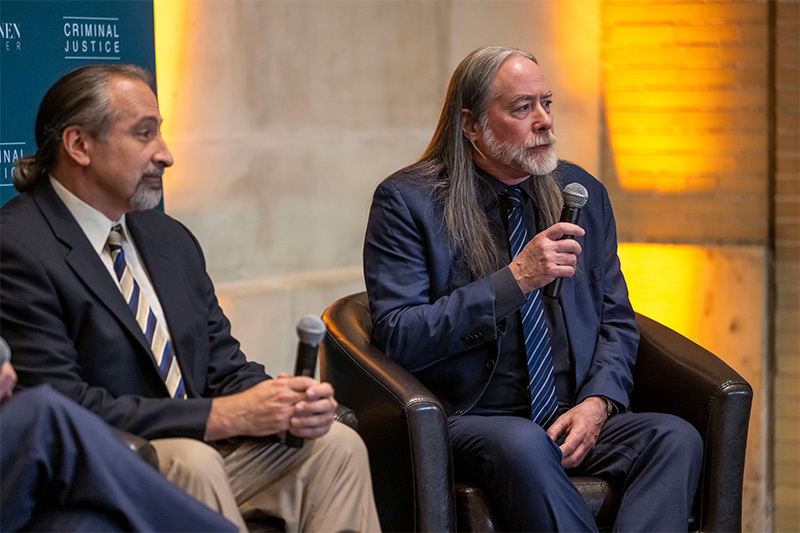
Experts with the Regional Gun Violence Research Consortium (RGVRC) address different facets of firearm violence from a variety of perspectives and disciplines. In this new series, get to know our experts and learn more about their contributions to better understand, prevent, and respond to the public health crisis of firearm violence. Get to know David Kennedy, a member of the RGVRC, a professor of criminal justice at John Jay College of Criminal Justice in New York City, and the director of the National Network for Safe Communities at John Jay.
Why do you study gun violence? Why is this an important area of research and how do you see your work helping to address this issue?
Everybody close to violence—as a victim, as a perpetrator, as a researcher—knows that violence is special. No setting—whether a country, a city, a workplace, a school, a relationship—is right when there is violence or the fear of violence. My commitment has always been to do something about violence, with the immediacy and the impact the issue deserves.
Award-Winning Research
Congratulations to David Kennedy for winning the prestigious Stockholm Prize in Criminology for 2027 for his work on preventing lethal violence. Click to learn more about the award and David’s research.
What is your research focus related to gun violence? What are you currently researching?
I’m focused on what we need to know and do to prevent violence in the most immediate way possible. There are very important long-term agendas here, and they properly get a lot of attention. My commitment is to the proximate: while we do that other work, what do we do right now? That begins with a clear empirical understanding of what’s happening on the ground, which for all forms of violence, short of war and genocide, leads to the core fact of enormous concentration by person and by place, and very often to dynamics involving groups and networks rather than individuals as such.
It then turns out that there are several fundamental ways we can have rapid, powerful impact on those extremely active and high-risk people: we can support them in their lives, we can exercise what academics call informal social control, and we can use the law. All of my work has involved getting that empirical picture right and figuring out effective ways to mobilize those capacities. One thing I’m doing right now, for example, is moving the “problem analysis” techniques for identifying local violence dynamics out of law enforcement, where they’ve always been located, into strictly community-based violence intervention. Happily, that’s going very well and feels extremely promising. I’ll be with partners from New York City government and a CVI organization on Staten Island presenting this work at the upcoming American Society of Criminology conference in Chicago.
What do you hope that people can take away from the research you are conducting?
From my research, the most important thing is simply that there now is “evidence-based” violence prevention: there are things we know how to do that make a really meaningful difference, quickly. That wasn’t true until very recently, but it is now. And if we know that, if we know that we can do the work that will make such a profound difference, then we really should consider it a moral obligation to do it.
Learn more about David and his work for the Regional Gun Violence Research Consortium below.