
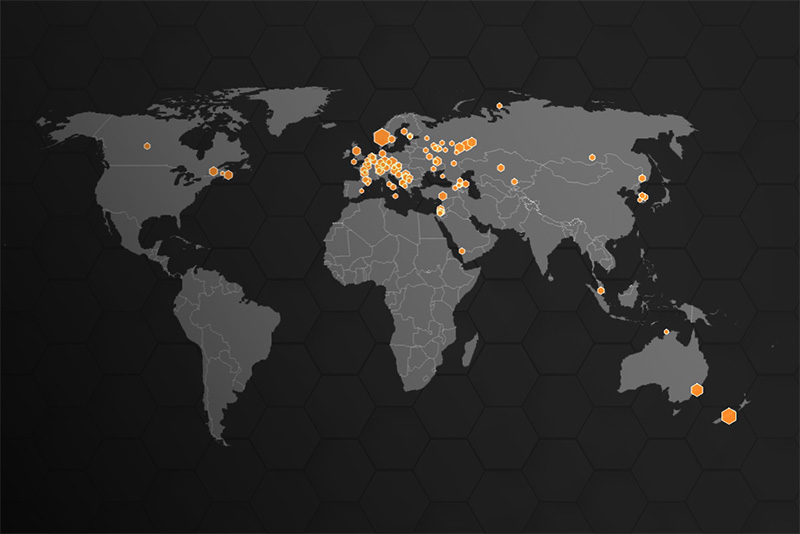
Today, we’re sharing a new resource for understanding mass shootings as a global phenomenon and contextualizing the occurrence of these events in the United States. The Global Mass Shooting Factsheet provides a high-level overview of mass shootings across more than 70 nations, offering details about how and where these events occur. Click here to view the factsheet.
Introduction
Mass shootings in the United States have received extensive media attention, public concern, and calls for prevention efforts in the 21st century. However, shootings in recent years, such as those at Campus Risbergska in Sweden, Dreierschutzengasse Secondary School in Austria, and Bondi Beach in Australia (all of which occurred in 2025), illustrate that mass shootings are not solely an American problem. These attacks underscore the importance of developing a broader understanding of how mass shootings affect countries around the world.
To support these efforts, the Global Mass Shooting Database (GMSDB) was created to provide a comprehensive resource examining the prevalence, characteristics, and evolution of mass shootings worldwide. Determining how and where these attacks occur internationally is critical for informing public discussion, improving prevention efforts, and placing US incidents into a broader comparative context. Ultimately, the GMSDB helps identify both shared patterns and important differences in how mass shootings occur across nations. The current factsheet uses data from the GMSDB to provide timely, public-facing information on the continued evolution of these attacks around the world.
GMSDB Mass Shooting Definition
The global mass shooting data includes completed, public mass shootings. For the purposes of this dataset, a completed mass shooting refers to an incident involving at least four victims killed (excluding the offender) within a 24-hour period. A public mass shooting refers to an incident occurring in a public or populated location, with the majority of victims targeted at random and/or for their symbolic value. Public mass shootings exclude family-related shootings, felony-related shootings, and incidents involving state-sponsored violence, battles over sovereignty, or organized terrorism.
In 2024, the Regional Gun Violence Research Consortium (RGVRC) first published findings drawn from my research with the GMSDB, examining the frequency, context, and prevention of mass shootings in the United States and 35 other economically and politically comparable countries between 2000 and 2022.1 That previous analysis identified 109 mass shootings in the United States and 35 mass shootings across the other 35 comparison countries, illustrating that the prevalence of incidents in the United States was exceptionally high relative to its peer nations.
At the same time, the earlier findings illustrated that mass shootings were not entirely isolated to the United States. France, Germany, and Canada each experienced four or more mass shootings during the 23-year study period. Additionally, the number of attacks across the comparison countries doubled from 2000–10 to 2011–22, with the highest annual totals occurring in 2019 and 2020. Notably, eight countries also experienced their first mass shooting after 2010: Australia, Austria, Belgium, Canada, the Czech Republic, the Netherlands, New Zealand, and Norway.
These findings raised concerns over the potential globalization of mass shootings. In other words, concerns that as American news media and entertainment culture continue to spread internationally, the idolization of American mass shooters and the potential for contagion and copycat effects may also spread across countries. To better understand these developments, data from the GMSDB were used to expand and update the prior consortium analysis to include additional years, new countries, additional variables, and an interactive public-facing factsheet.
Updated Insights on Global Mass Shootings
The Global Mass Shooting Factsheet, our new resource, provides insight into international mass shootings between 2000 and 2025. Key advancements include three additional years of data (2023–2025) for the original 35 countries, along with the inclusion of 38 additional countries. The updated resource now includes all countries (excluding the United States) classified by the United Nations as having a “very high” Human Development Index (HDI) score, allowing for comparisons across countries with broadly similar levels of educational access, life expectancy, and socioeconomic development.
The factsheet also provides a more comprehensive and interactive resource than our previous blog and accompanying analysis. In addition to expanding the number of countries and years analyzed, a key feature of this update is the new interactive event map that allows users to explore the geographic distribution of incidents alongside event-level information such as location type, casualty counts, firearms used, offender demographics, and incident dates. Additional variables examining patterns across days of the week and times of day have also been incorporated to provide greater insight into when these attacks occur.
With this expanded data, which will be updated annually, we can now better assess how mass shootings continue to evolve internationally. Some key findings from the most recent update include the following:
- Between 2000 and 2025, a total of 99 mass shootings were identified across the 73 “very high” HDI countries.
- The number of incidents increased substantially over time, with 35 mass shootings occurring during the first half of the study period (2000–2012) compared to 64 during the second half (2013–2025). The highest annual total occurred in 2016 (8 incidents), followed by 2020, 2022, and 2023 (6 incidents each).
- Mass shootings remain highly concentrated within a relatively small number of countries. More than half (59 percent) of the 73 countries did not experience a single mass shooting between 2000 and 2025.2
- While France, Germany, and Canada remain among the countries experiencing the highest number of incidents, the updated data also identified Turkey, Israel, Serbia, and Russia as countries experiencing four or more mass shootings between 2000 and 2025.
- Croatia, Georgia, Montenegro, and Sweden experienced their first mass shootings during the 2020s, further illustrating the widening geographic distribution of these attacks.
Taken together, these findings suggest that mass shootings remain relatively rare in most countries outside the United States, but they are increasingly affecting a broader range of countries over time.
The United States in Context
Between 2000 and 2025, the current factsheet identifies 99 mass shootings across 73 “very high” HDI countries outside the United States. During the same period, however, the United States alone experienced 121 mass shootings. Since the prevalence of mass shootings in the United States differs substantially from other comparable countries, US cases were excluded from the current factsheet to provide a clearer picture of how mass shootings occur across the rest of the world. That said, it remains valuable to contextualize the current findings in relation to the US problem.
- The 99 mass shootings across 73 countries claimed the lives of 804 people and left 665 wounded by gunfire. By comparison, 121 US mass shootings claimed 943 lives and left 1,095 people wounded. Despite the greater number of casualties in the United States, the average number of fatalities per incident was relatively similar across groups (8.1 vs. 8.0). However, US incidents resulted in a higher average number of people wounded by gunfire (9.1 vs. 6.7).
- Outside the United States, mass shootings more commonly occurred in open-area (30 percent) and government locations (21 percent).3 In contrast, US mass shootings more frequently occurred at commerce locations (55 percent).
- The firearms used in mass shootings also differed across contexts. Outside the United States, incidents more commonly involved at least one rifle (56 percent) and, to a lesser extent, at least one shotgun (27 percent). In contrast, US mass shootings more frequently involved multiple firearms (57 percent) and at least one handgun (73 percent).
Despite these cross-national differences, some offender characteristics are notably consistent. Across countries, mass shooters are overwhelmingly male, with an average age of 34 years old. These similarities suggest that, although the prevalence and situational dynamics of mass shootings vary across countries, other underlying offender characteristics transcend national context. At the same time, the substantial differences in incident frequency and weapon use underscore the importance of examining how broader social, cultural, and firearm-related factors may influence both the prevalence and severity of mass shootings across countries.
What the Factsheet Tells Us
Overall, the current factsheet reinforces the importance of examining mass shootings in a global context. While mass shootings remain relatively rare in most countries around the world, the growing number of affected countries and the increase in incidents over time suggest that these attacks are emerging as a broader international phenomenon. As mass shootings continue to affect communities across multiple nations, it remains important to better understand both the shared patterns and country-specific differences associated with these attacks. Comparative international research can help place US mass shootings into a broader global context while also identifying trends that may inform future prevention and harm-reduction efforts. Ultimately, the current factsheet is intended to support more informed public discussion and evidence-based approaches for understanding and addressing mass shootings worldwide.
ABOUT THE AUTHOR(S)
Jason R. Silva is an associate professor in the Department of Sociology, Criminal Justice, and Social Work at William Paterson University.
- These comparative countries, similar to the United States, were drawn from the United Nations’ criteria for “developed countries.” These 35 countries included Australia, Austria, Belgium, Bulgaria, Canada, Croatia, Cyprus, Czech Republic, Denmark, Estonia, Finland, France, Germany, Greece, Hungary, Iceland, Ireland, Italy, Japan, Latvia, Lithuania, Luxembourg, Malta, Netherlands, New Zealand, Norway, Poland, Portugal, Romania, Slovakia, Slovenia, Spain, Sweden, Switzerland, and the United Kingdom. ↩︎
- Countries without a mass shooting include Andorra, Antigua and Barbuda, Argentina, Bahamas, Bahrain, Barbados, Belarus, Bosnia and Herzegovina, Brunei, Bulgaria, Chile, Costa Rica, Cyprus, Denmark, Estonia, Greece, Hong Kong, Hungary, Iceland, Ireland, Japan, Kuwait, Latvia, Liechtenstein, Lithuania, Luxembourg, Malta, Mauritius, North Macedonia, Oman, Panama, Poland, Portugal, Qatar, Romania, Saint Kitts and Nevis, San Marino, Seychelles, Singapore, Slovenia, Trinidad and Tobago, United Arab Emirates, and Uruguay. ↩︎
- Most government-related attacks in other countries (76 percent) involved offenders with military backgrounds targeting their workplace, particularly in Russia and South Korea. ↩︎