

Meaning
As conditions generally continue to warm due to climate change, the habitat for many species in the eastern United States will likely move northward and westward. Unfortunately, many species lack the ability to adequately track and/or adapt to these changes.1 Assisted migration describes human practices that deliberately move species, organisms, or genes to areas where they weren’t previously found. In most cases, assisted migration more specifically describes when species, organisms, or genes are moved for the purpose of relocation to a more adequate habitat due to the impacts of climate change on their environment. Assisted migration is not limited to addressing climate-related hazards, and could include other temperature, precipitation, or sea level-related changes.
A wide variety of living organisms could be considered for movement, as the general concept may be applied to any living organism. Several US-based projects have been discussed but not implemented. Two such examples include the Quino Checkerspot butterfly, which is threatened by climate change and habitat loss, and the Key deer, a mammal that only lives on islands in the Florida Keys that are threatened by sea level rise. An unofficial, activist-driven migration of a critically endangered tree species, the Florida Torreya, has grown reproductively capable members of the Florida species as far north as Ohio.
The concept of assisted migration was first proposed in 1992 as a mechanism to mitigate the impacts of climate change. The initial concept was raised amid concerns regarding reduced US forest cover and associated timber harvests, indicating that to maintain stock, “[p]lanting programs may have to deploy non-local seed sources, imported from further south or from lower elevations…”2 This earlier effort could be considered an example of what’s called resilience-focused assisted migration, where the goal is to maintain an overall resilient ecosystem in the target location, and the species being introduced are not necessarily of a particular conservation concern.
In the following years, more conservation-focused goals have been discussed with respect to assisted migration with greater frequency. In these situations, species, organisms, or genes would be moved outside of their current range to ensure persistence in the future. Therefore, the target of concern is no longer the area something is being moved to, but the thing being moved. This might be done because a species lacks the ability to track suitable climate conditions itself and could be at risk of extinction. This was recently reflected in the Endangered Species Act (ESA), in which language was amended in 2023 relating to the “historical range” of a species.3 The change allowed for populations to be introduced outside of previously occupied areas for conservation purposes.
Purpose and Distance
Assisted migration practices have been categorized by the extent of the movement being considered.4
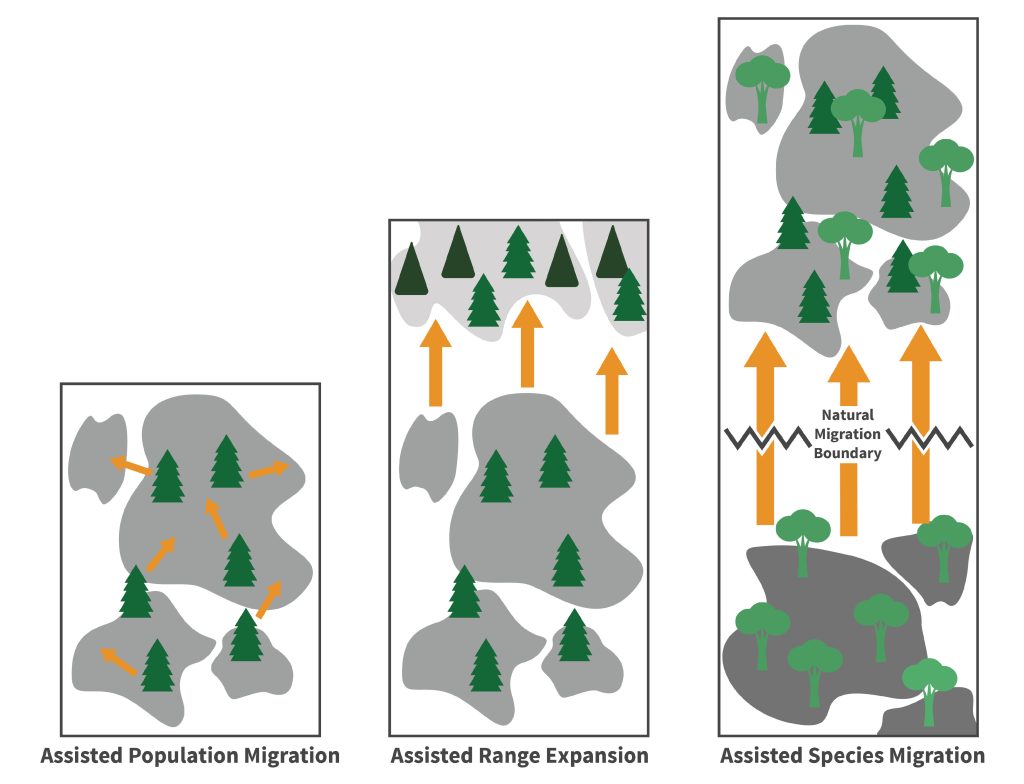
SOURCE: “Assisted Migration,” Climate Change Resource Center.
In assisted population-level migration, a species is not moved to a new location; instead, genetic material from a different population is intentionally introduced into a population of the same species. This may take the form of introducing reproductively capable individuals who can pass on genetic material in the new location. Because different populations have locally adapted traits, introducing these new individuals can help the original population handle changing climate conditions. For example, transferring genetics from a more southern population capable of withstanding warmer conditions to a more northern population may help the latter adapt as the climate warms.
In assisted range expansion, species are moved slightly outside of their native range to promote establishment prior to their arrival via natural dispersal. Preemptively establishing some individuals can help ensure survival in the introduced area and diversify the age structure.
In assisted species migration, species are moved outside the scope of their perceived natural dispersal abilities. This may include movement over natural barriers (mountain range), man-made barriers (a city), or over great distances.
Recent legislation introduced in New York (S 1690A/A 3030 of 2025–26) would additionally codify the definition and subsequent use of native plants in New York.5 That definition would explicitly include assisted climate migration. If enacted, this would explicitly permit resilience-focused assisted migration efforts.
Potential Implementation and Risks While assisted climate migration may serve as a tool to address resiliency or conservation concerns, implementation would require background research similar to other ecological projects. For instance, locations would need to be carefully selected to ensure the relocated species/organism/genes could survive in the new location both under the present-day conditions and under projected future conditions. Concerns regarding unintended impacts of the moved species, organism, or genes in the new location would also need to be studied to ensure they could be moved safely without a large amount of risk.
ABOUT THE AUTHOR(S)
Timothy Morris is a New York State science policy fellow at the Rockefeller Institute of Government.
- Scott R. Loarie, et al., “The velocity of climate change,” Nature 462 (2009): 1052–5. ↩︎
- F. Thomas Ledig and J. H. Kitzmiller, “Genetic strategies for reforestation in the fact of global climate change,” Forest Ecology and Management 50 (1992): 153–69. ↩︎
- US Fish and Wildlife Service, Department of the Interior, Rule, “Endangered and Threatened Wildlife and Plants; Designation of Experimental Populations,” Federal Register 88 (July 3, 2023): 42642–52. ↩︎
- Stephen Handler, et al., “Assisted Migration,” Climate Change Resource Center, December 12, 2023. ↩︎
- S.B. S1690A, 2025–26 Leg. Sess. (NY 2026). ↩︎