
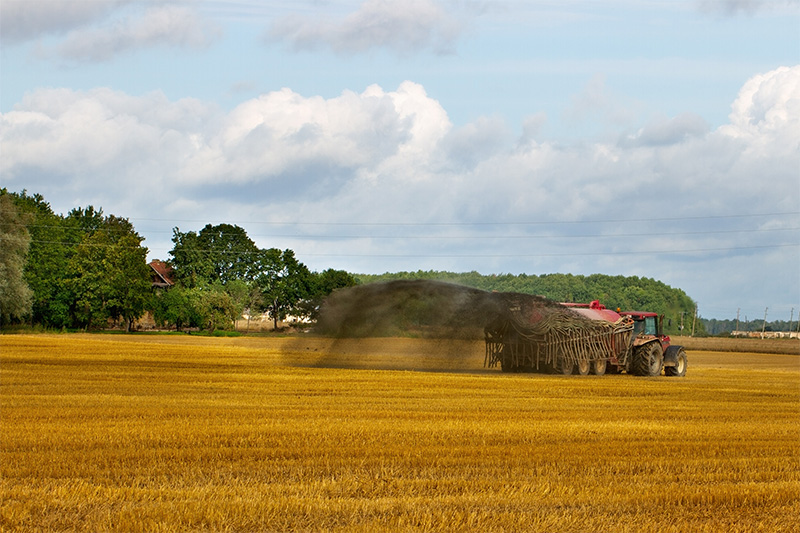
In our 2024 PFAS Policy Dashboard update, we first highlighted biosolids as one of the emerging areas of state PFAS legislation. As outlined previously, PFAS—or per- and polyfluoroalkyl substances—are a class of human-made chemicals, also commonly referred to as “forever chemicals.” Biosolids are treated organic material, like compost, derived from sewage sludge or byproducts that may be applied to soil as a “beneficial use.” At the time, we noted increased attention to biosolids alongside agriculture, animals, and food. In our recent update to the Dashboard, which newly includes 2025 state legislation (from January to December 2025), biosolids, along with agriculture, groundwater, soil, and wastewater, all saw a marked rise in the number of bills introduced. This includes bills in New York State, which, in recent years, has seen localized cases of PFAS contamination in Steuben and Albany Counties associated with the land application of biosolids.
As we’ve written about previously, PFAS can enter wastewater systems as a consequence of various sources—including industrial discharges, firefighting foam, and consumer products, among others—that then impact water and/or wastewater systems. The presence of PFAS in biosolids draws from its presence in wastewater (also referred to as influent) and the ways in which typical wastewater treatment processes that produce treated wastewater (effluent) and biosolids (residuals) do not treat for PFAS and can instead concentrate them. Existing research has demonstrated the pathways through which PFAS can move into wastewater—from wastewater into biosolids, and from biosolids into the further environment—therein resulting in further human exposures. This next part in our blog series outlines some of the more recent developments (and lack thereof) in federal and state regulation and legislation.
What Are PFAS?
PFAS are human-made chemicals that have been produced and used in the United States since the 1940s for a variety of industrial and consumer products in order to make them nonstick, water-repellent, and fire-resistant or suppressive. They have strong carbon-fluorine bonds, which make them persistent in the environment and hard to break down. A number of PFAS compounds have been found through research to have generally shared characteristics of being persistent, bioaccumulative, and toxic. Exposure to PFAS compounds has been linked to negative human health impacts, including cancers, thyroid issues, and reproductive and developmental impacts. Additionally, researchers have noted the need for further testing and studies of communities that have been exposed to better understand other potential health impacts.Federal Rulemaking, Lack Thereof, and Lawsuits
As we’ve noted in earlier parts of this series, federal rulemaking on PFAS in biosolids has been slow-moving and largely absent, even as mounting scientific evidence and cases of contamination on farms and in agricultural products have prompted legal action. Some private companies have, for example, faced lawsuits for their sale and marketing of biosolids that contained PFAS as ‘environmentally friendly.’ Likewise, the longer absence of federal regulatory action has been the subject of further lawsuits. In 2024, the advocacy organization Public Employees for Environmental Responsibility (PEER) filed a suit against the Environmental Protection Agency (EPA) on behalf of certain farmers and farming and environmental organizations for failing to further address PFAS in biosolids regulations. The EPA then moved to dismiss the lawsuit in September of 2024.
Just a few months later, in the final weeks of the Biden administration (on January 14, 2025), the EPA did, however, release a Draft Sewage Sludge Risk Assessment for Perfluorooctanoic acid (PFOA) and Perfluorooctane sulfonate (PFOS), two specific PFAS compounds. In May 2025, under the second Trump administration, the EPA extended its public comment period on the Draft Assessment. It was expected that the EPA would then finalize that Draft Assessment and that it would further propose standards for PFAS in biosolids. This movement was, however, reportedly met with some political opposition. Moreover, while the comment period ended in August 2025, no further federal regulatory action has been taken.
Since then, in October 2025, a federal judge dismissed the lawsuit against the EPA by PEER. US District Judge Dabney Friedrich found that “[a]lthough the plain language of the CWA [Clean Water Act] imposes a non-discretionary duty on EPA to review its regulations on a biennial basis, it does not mandate that EPA also identify and regulate sewage sludge pollutants within the same time frame.” This means that although the agency needs to produce the Biosolids Biennial Review every two years (as discussed earlier in this series) to identify contaminants for potential regulation, it does not need to take further regulatory action stemming from that review within a particular amount of time. That decision was appealed by the Plaintiffs in November 2025. For now, the EPA has recommended that states monitor sewage sludge for PFAS.
New York State Rulemaking and Legislation
Background Levels and Soil Cleanup
“Background” levels have been an important facet of the regulatory discussion around cleanup levels in soil and other environmental media (like air and water). Such background levels, also sometimes referred to as ambient levels, generally represent the concentration of PFAS in a particular type of environmental media that are generally found in the area or similar types of areas and have not been traced to a particular source. Background levels can include naturally occurring or anthropogenic contaminants. In this case, anthropogenic refers to contamination as a result of human activity, whether the contaminants themselves are human-made or not. Establishing the background or ambient level of a contaminant in a particular medium and/or location helps regulatory agencies determine the cleanup values and assess what level of contamination is attributable to a potentially responsible party. EPA guidance on soil cleanup (under CERCLA or the federal Superfund Law) defines background as:
Substances or locations that are not influenced by the releases from a site and are usually described as naturally occurring or anthropogenic: (1) Naturally occurring substances present in the environment in forms that have not been influenced by human activity. (2) Anthropogenic substances are natural and human-made substances present in the environment as a result of human activities (not specifically related to the CERCLA site in question).
Industry advocates, including potentially responsible parties who were identified as the source of PFAS contamination for a particular site, have argued that they should not be required to clean up or remediate sites to lower than what is considered the background level for PFAS, while researchers and environmental advocates have highlighted that no level of PFAS is ‘naturally occurring’ and low levels of exposure have been linked to health impacts. This discussion is particularly poignant because PFAS are so widespread in the environment at a global level in soils and waters, as well as more regionally in the United States, including on farms in the northeast.
In 2023, the New York State Department of Environmental Conservation (DEC) commissioned a background study of PFOA and PFOS in rural soils across New York State. In that study, 548 soil samples from 116 properties that were not near any known PFAS source were collected. The purpose of the study was “to assess the background PFAS data set to ensure that it is representative of anthropogenic background PFAS concentrations from diffuse, non-localized or non-point sources of PFAS rather than identifiable point source signatures such as those that would result from a facility or group of facilities.” PFOS was at a detectable level in over 97 percent of surface soil samples, and PFOA was detected in over 76 percent. As a result of these findings, the DEC established background soil concentrations using an Upper Tolerance Limit (UTL), a statistical threshold below which a specified percentage of a dataset falls at a defined confidence level. Using this approach, the DEC established background concentrations of 3.0 ug/kg for PFOS (or 3 parts per billion (PPB)) and 1.5 ug/kg (or 1.5 PPB) for PFOA.
Other states have taken different approaches. New Hampshire outlined separate background levels for northern and southern regions of the state. For PFOS, background threshold value (BTV) ranges from 4 μg/g in northern New Hampshire to 6 μg/g in southern New Hampshire. For PFOA, BTV ranges from 3 μg/g in northern New Hampshire to 4 μg/g in southern New Hampshire. PFHxS BTV ranges from 2 μg/g in northern New Hampshire to 4 μg/g in southern New Hampshire, and for PFNA BTVs are 1ug/g statewide. For reference, a 2020 meta-analysis of studies (across several countries, including the US) on PFAS levels in soil found that for those studies measuring background levels, “the median maximum concentrations were 2.7 μg/kg for both PFOS and PFOA.”
In June 2024, the New York State DEC issued a revised Draft CP-51 (originally published in 2010), which provided initial regulatory guidance for PFAS with respect to soil, though it did not establish soil cleanup objectives (SCOs) for any PFAS. SCOs are used to identify areas of contamination and the extent thereof, as well as in the development of soil cleanup levels for a particular site. The objectives may vary depending on the site and the protection goals involved—groundwater protection, ecological resource protection, public health, or unrestricted use standards. The DEC can also use approved methodologies with limited modification to determine soil cleanup levels for a site that may be different from existing SCOs or develop site-specific SCOs in some cases. The Draft CP-51 noted that the values included in the document were meant to be used “until SCOs for per- and polyfluorinated alkyl substances (PFAS) such as PFOA and PFOS are established.” It further noted that cleanup values should be established on a case-by-case basis in the interim and included the following as guidance values (see Table 1).
Table 1: New York State Guidance Values for PFOA & PFOS in Soil
| Guidance Values for Anticipated Site Use | PFOA (ppm) | PFOS (ppm) |
|---|---|---|
| Unrestricted | 0.00066 | 0.00088 |
| Residential | 0.0066 | 0.0088 |
| Restricted Residential | 0.033 | 0.044 |
| Commercial | 0.5 | 0.44 |
| Industrial | 0.6 | 0.44 |
| Protection of Groundwater | 0.0008 | 0.0010 |
More recently, in December 2025, there was an update to a state regulation for environmental remediation programs under 6 NYCRR Part 375 (including the Brownfield Program, the State Superfund Program, and the Environmental Restoration Program) to establish SCOs. No PFAS were included in the list of contaminants with soil cleanup objectives.
Biosolids Testing
In December 2025, the DEC did, however, issue a draft program policy (DMM-7A) pertaining to PFAS substances in biosolids. The draft policy builds on a 2023 program policy establishing an Interim Strategy for the Control of PFAS Compounds (DMM-7). The 2023 program policy required permitted facilities that accept biosolids to sample the source facility for PFOA and PFOS and report the results to the DEC. The policy also noted at that time that the “EPA is currently developing comprehensive risk-based standards for PFAS compounds in biosolids that are recycled. DEC intends to initiate a rulemaking for Part 361 after the EPA standards are established.” Given shifts in federal regulatory action and guidance since then, the new 2025 draft policy by the state appears to indicate a change to that approach.
The new draft policy would require sampling and analysis of soil products produced from biosolids, like compost. It would also require that:
Within 90 days of the issuance of this policy, all currently permitted 361-3 facilities that accept biosolids, as well as facilities with approvals under Subpart 361-3.8 to distribute biosolids products from out of state sources, must sample the biosolids product for PFAS compounds and provide the samples to a New York State Department of Health (NYSDOH) certified laboratory. The results must be submitted to DEC upon receipt from the laboratory. DEC will publish the data received.
It is important to note that this is a draft program policy which has not been formally issued as of this writing, and therefore, the 90-day time period given for sampling has not yet started. The draft policy further, and notably, states that the intent of this requirement is to then provide data that the agency can use to inform “the development of future rulemaking” and “determine the impact the proposed PFAS standards in the rulemaking will have on New York State Facilities.” The policy contextualizes this future rulemaking and the need for data regarding the potential for leachate from biosolids to impact groundwater, crops, and human health. Accordingly, the new sampling and testing required will be used to support the development of state standards for PFAS in biosolids.
State Legislation
Along with these regulatory developments, there have also been legislative efforts in New York to address PFAS in biosolids. In February 2025, A 6192/S 5759 was introduced and proposed a five-year moratorium on land application of biosolids. In June 2025, the state Senate passed the bill, but it later stalled in the Assembly. Lawmakers have reintroduced the bill this year, and advocates, along with industry or member associations, have continued to engage on this bill (including Environmental Advocates of New York, Northeast Biosolids and Residuals Association, and New York Water Environment Association). Proponents of biosolids argue that there is not enough evidence connecting human health risks and biosolid land application, that biosolids provide valuable nutrients like nitrogen, phosphorus, sulfur, and potassium that are needed for agriculture, and land application of biosolids can help with carbon sequestration. Proponents also argue that land application is more environmentally friendly than alternative disposal options such as incineration and landfilling. Opponents, however, argue that the PFAS exposure risk is too high and threatens to pollute the environment and food supply, and thereby results in further human exposures. The New York State Farm Bureau recently changed its stance on this issue. Previously, the organization advocated for biosolid land application, but in December 2025, they announced that they now oppose the land application without testing standards for PFAS and heavy metals.
This issue also intersects with other waste goals. In particular, as outlined earlier in this series, New York City has committed to diverting 100 percent of its biosolids away from landfills by 2030 to “beneficial uses” as part of a broader climate strategy. Currently, the city produces approximately 1,300 wet tons of dewatered biosolids, and most are landfilled. Reaching this commitment will therefore require a significant transition toward “beneficial use,” which includes land application and composting, further underscoring the importance of defining PFAS standards for soil and biosolids that are protective of environmental and human health.
2025 Legislative Actions
In our 2025 State PFAS Policy update, we identified 26 new pieces of legislation across 17 states that addressed biosolids (Arizona, Connecticut, Georgia, Indiana, Maryland, Massachusetts, Minnesota, Mississippi, New York, Oklahoma, Oregon, Pennsylvania, Rhode Island, Texas, Vermont, Washington, and Wisconsin). As of May 2026, six of these legislative efforts were successfully enacted into law in Washington (which enacted two laws), Rhode Island, Oregon, Wisconsin, and Connecticut. Table 2 provides more details about the biosolid legislation taken up in 2025.
Table 2: Biosolid Legislation in 2025
| State | Bill Number | Status (as of May 2026) | Main Purpose of Legislation |
|---|---|---|---|
| Arizona | H.B.2646 | Introduced | Prohibits the distribution and use of any fertilizer including biosolids and sewage sludge that contain PFAS |
| Connecticut | S.B. 0883 | Introduced | Adopts Maine’s PFAS-related legislation and regulations and provides guidelines for the use of biosolids in farming. |
| Connecticut | S.B. 01497 | Enacted | Prohibits the sale and use of biosolids as fertilizers that contain PFAS |
| Indiana | H.B. 1553 | Introduced | Establishes PFAS testing guidelines and sets restrictions on PFAS concentrations for biosolids. |
| Georgia | H.B. 211 | Introduced | “PFAS Receiver Shield Act” grants legal immunity to businesses and individuals who use or handle PFAS |
| Maryland | H.B. 909/ S.B.732 | Introduced | Requires certain sewage sludge utilization permits issued or renewed by the Department of the Environment to limit the concentration of certain |
| Massachusetts | H. 2450/ H. 4870 | Introduced | Requires the department of health to develop a public health campaign to educate the public about PFAS pollution including biosolid PFAS contamination. |
| Massachusetts | H. 109/ H. 4853 | Introduced | Establishes the Agricultural PFAS Fund and provides civil immunity in some cases. |
| Minnesota | S.F. 3091/ H.F. 2577 | Introduced | Grants the commissioner power review the records of sewage sludge transfers, to investigate PFAS contamination. |
| Mississippi | S.B. 2004 | Introduced | Requires testing of wastewater for PFAS and establish parameters for spreading biosolids. |
| New York | A.06192/ S. 05759 | Introduced | Establishes a moratorium on the sale and use of biosolids. |
| Oklahoma | H.B. 1726/ S.B. 268 | Introduced | Prohibits the land application of biosolids. |
| Oklahoma | H.B. 3403 | Introduced | Creates the Oklahoma Biosolids Land Application Research Pilot Program |
| Oklahoma | S.B. 3 | Introduced | Prohibits the land application of biosolids and sludge. |
| Oklahoma | S.B. 620 | Introduced | Requires the disclose the use of biosolids for agricultural products and land application. |
| Oregon | H.B. 2947 | Enacted | Directs Oregon State University to study the distribution and occurrence of PFAS in biosolids. |
| Vermont | H. 0425 | Introduced | Creates regional long-term plan to deal with septage, sewage sludge, and biosolids |
| Vermont | H. 0292 | Introduced | Requires the Secretary of Natural Resources to create a regional long-term management plan for biosolids. |
| Pennsylvania | H.B. 1116 | Introduced | Directs the Department of Environmental Protection to conduct a study on PFAS chemicals in biosolids. |
| Rhode Island | S. 0650/H.5844 | Enacted | Requires quarterly testing of biosolids for PFAS |
| Texas | H.B. 290 | Introduced | Adds restrictions on the sale and distribution of biosolids in Johson County, Texas. Declares an emergency. |
| Texas | S.B. 886/ H.B. 1674 | Introduced | Requires manufacturers to test biosolids for PFAS and establishes maximum allowable concentration limits for specific PFAS compounds. |
| Washington | H.B. 1198/ S.B.5167 | Enacted | Appropriates funds for Biosolid permit account |
| Washington | S.B. 5033 | Enacted | Requires testing of biosolids for PFAS and mandates a comprehensive study. |
| Wisconsin | A.B. 131/S.B. 128 | Enacted | Creates a grant program to test for PFAS and spills law exemption. |
| Wisconsin | A.B. 130/S.B. 127 | Introduced | Creates specific liability exemptions for certain entities dealing with PFAS contamination. |
Liability Protection Legislation
This body of legislation introduces further approaches to addressing the issue of biosolids contaminated with PFAS, including liability protections. For example, in Wisconsin, A.B. 131 focuses on liability and seeks to prevent the Department of Natural Resources from holding certain parties responsible for PFAS contamination costs if following the law and regulations at the time. This includes protections for farmers, homeowners, and municipalities who spread biosolid or wastewater residuals in compliance with their applicable permits. This bill would also create an Innocent Landowner Grant Program, which offers $250,000 per eligible person to help with remediation or testing on land where contaminated biosolids were applied. Additionally, the bill allocates funding for municipal testing and remediation to help local governments monitor PFAS, including grants for sampling PFAS in biosolids and wastewater before they are land-applied, a similar prescreening approach to that of Rhode Island and Washington. This bill further provides funds for municipalities and privately owned landfills to dispose of PFAS-contaminated biosolids at specialized facilities or to install on-site treatment facilities. The funds provided can also be used to connect private well owners to municipal systems if their groundwater was contaminated by local biosolid application. Massachusetts’ proposed H. 4853/ H. 109 similarly would provide farmers immunity from lawsuits and civil liability for any damages resulting from PFAS present in soil, water, livestock, or agricultural products as a result of standard agricultural practices or a source of contamination outside their control. Georgia’s proposed H.B. 211 would provide immunity from certain lawsuits for PFAS receivers. This bill defines PFAS receivers as any person or entity that is not a PFAS manufacturer. More specifically, the bill states that receivers include a person or entity who uses or applies PFAS substances in the manufacture of goods or in agriculture, receives or obtains goods or products that contain PFAS, purchases or owns goods that contain PFAS, or a person or entity who is licensed, permitted, and regulated to receive industrial or household solid waste or wastewater that contains PFAS.
Study/Research Legislation
In Washington, Governor Bob Ferguson signed S.B. 5033 into law, a measure that prioritizes increased transparency and mandates a comprehensive study. Under this legislation, the Department of Ecology is required to publish formal guidance pertaining to PFAS sampling by July 1, 2026. This guidance must clarify the methodology and frequency wastewater facilities must use for biosolids sampling. Under the law, facilities must sample biosolids for PFAS at least quarterly between January 1, 2027, and June 30, 2028. By September 2028, all wastewater facilities must submit their results to the Department of Ecology. Additionally, by July 2029, the Department of Ecology must submit the final report to the Legislature explaining its findings and providing recommendations for future regulatory actions. Lastly, this law establishes an Advisory Committee that the Department of Ecology must consult with before making its 2029 recommendations. This committee must include representatives from the farming community, toxicologists, other health experts, and utilities that produce biosolids.
Similarly, Pennsylvania’s proposed H.B. 1116 requires a study of PFAS in biosolids. More specifically, this bill requires the Department of Environmental Protection to test the concentration of PFAS chemicals in biosolids used for land application on farmland, and to test the concentration of PFAS in the soil and water on and near farmland where biosolids are land applied, and in areas where biosolids are not land applied. This study also requires an analysis of the source of biosolids used for land application on farmland, an analysis of the potential pathways for the PFAS contamination of the food supply for humans resulting from the land application of biosolids, conducting a cost analysis of different treatment methods for reducing the concentration of PFAS, and an examination of the laws and regulations of other states regarding the testing or treatment for PFAS in land applied biosolids. Like Pennsylvania’s H.B. 1116, Oregon enacted H.B. 2947, which directs Oregon State University to study PFAS in biosolids that are applied on farmland that does not produce crops for human consumption. In Vermont, proposed H. 0425 would require that the House Committee on Environment and the Senate Committee on Natural Resources and Energy develop a regional long-term plan for septage, sludge, and solids management. This bill emphasizes the development of a safe and cost-effective biosolids management strategy that reduces or eliminates risks to public health or the environment. Oklahoma’s proposed HB 3403 requires establishing the Oklahoma Biosolids Land Application Research Pilot Program Act. Massachusetts’ H. 4853/H. 109, along with changes to liability, also mandates a study and a comprehensive statewide master plan.
Bans and Moratoriums
There have also been proposed bans during the 2025 legislative sessions. As previously mentioned, New York’s proposed A. 6192/S 5759 creates a five-year moratorium on the land application of biosolids. Vermont H. 0292 proposes a land ban on the application or sale of biosolids with the presence of PFAS. The bill also requires the Secretary of Natural Resources to adopt rules to establish a testing program for all biosolids, sewage sludge, or similar liquid prior to their beneficial use on land, and the Secretary must then test all biosolids, sewage sludge, or similar liquid wastes. This bill also prohibits landfill disposal of these materials where PFAS levels exceed the state standards for hazardous waste. Similarly, Oklahoma’s proposed S.B. 3 prohibits the land application of biosolids and restricts any new permit applications. This bill establishes a timeline for currently permitted entities to reduce biosolids applications and, within the year, fully stop them. Additionally, Oklahoma’s H.B. 1726/SB 268 also proposes a ban on the land application of biosolids. Mississippi’s S.B. 2004 also proposed a prohibition on the land application of sludge, along with mandating testing of biosolids for PFAS. Arizona’s H.B. 2646 proposes a ban on the distribution and sale of any biosolids that contain PFAS. Connecticut’s proposed S.B. 00883 attempted to adopt Maine’s strict prohibition and guidelines of sewage sludge in farming, but the bill ultimately failed to advance out of committee.
Other Restrictions
There have also been other proposed restrictions, such as Texas HB1674/B 886. This proposed bill requires that manufacturers of biosolids sample for PFAS. This bill sets limits for 17 different PFAS compounds in biosolids (PFBA, PFBS, PFPeA, PFHxS, PFHxS, PFHxA, PFHpA, PFOS, PFOA, FOSA, PFNA, PFDA, PFDS, PFUnA, PFDoA, PFTrA, and GenX). It further mandates that if, within a single calendar year, lab testing finds that two or more samples provided by the same manufacturer are above the limits set for PFAS compounds, it must have a stop-sale order, and the manufacturer’s permit to distribute biosolids would be suspended. Lastly, this bill establishes a criminal offense for intentionally or knowingly distributing biosolids that exceed PFAS limits. Texas HB 290 would similarly restrict the manufacturing, sale, distribution, and application of biosolids with exceedances of the same PFAS compounds specified in SB 886, but this bill only applies to counties with a population of more than 175,000 and less than 195,000 and is aimed at targeting the PFAS biosolid contamination in Johnson County. Additionally, Maryland’s S.B. 732/HB 909 proposes a limit for sewage sludge on PFOS and PFOA of less than 1 μg/kg. Similarly, Indiana’s proposed H.B. 1553 requires quarterly testing of biosolids and prohibits a person from applying biosolids that contain a concentration of more than 100 parts per billion of one or more PFAs.
Disclosure Requirements
There are also proposed disclosure requirements. For example, Oklahoma’s proposed SB 60 would require entities to disclose biosolid use, establish labeling requirements for products that include biosolids generated from wastewater treatment centers, and mandate disclosure to consumers who purchase an agricultural crop or vegetative material, such as landscaping greenery for which biosolids have been permitted to be applied. The bill also requires that property that is sold or leased shall include a disclosure if the property has been applied with biosolids, and that the biosolid land application property sites be published and updated annually.
Other Legislation
Other states are tackling additional aspects of this PFAS biosolid crisis. Minnesota’s proposed H.F. 2577/S.F. 3091 requires parties receiving or transferring sewage sludge to maintain a record. The Commissioner of Agriculture can review these records to investigate PFAS contamination. Massachusetts’s proposed H. 2450/H. 4870 requires that the Department of Environmental Protection, in collaboration with the Department of Health, develop a public awareness campaign to educate state residents about PFAS contamination and potential health impacts, and specifically to inform the public about the routes of PFAS exposure, including biosolids.
2026 Updates
Some of these trends have continued into 2026. For example, as of April 2026, Virginia Governor Spanberger signed into law S.B. 386 and H.B. 1443, which take a similar approach to Michigan’s interim strategy. This law prohibits the land application, marketing, and distribution of biosolids that are more than 50 μg/kg of PFOS or PFOA. Additionally, at this level, the biosolids must be disposed of by alternative means (landfilled or incinerated). If biosolids contain 25-50 μg/kg of PFOS or PFOA, land application is permitted but restricted. It is capped at a 1.5 dry tons per acre rate, and the permit holder must notify the landowner at least two weeks before land application. Biosolids with less than 25 μg/kg of PFOS or PFOA can be applied to land with no additional requirements.
Conclusion
The regulation of biosolids is currently a rapidly shifting field where state-level actions are outpacing federal regulatory guidance and action. As the EPA continues to reevaluate its national risk assessments, states will likely continue to propose, promulgate, and enact a handful of strategies to address PFAS in biosolids, including biosolids bans in states like Maine, conditional or restricted uses in states like Michigan, and other legislative approaches like Wisconsin’s proposed changes to liability. Over the next few years, these state-level approaches will continue to be rolled out, and we will continue to monitor their implementation and impacts.
ABOUT THE AUTHOR(S)
Laura Rabinow is director of research at the Rockefeller Institute of Government.
Mathilda Scott is a policy analyst at the Rockefeller Institute of Government.