
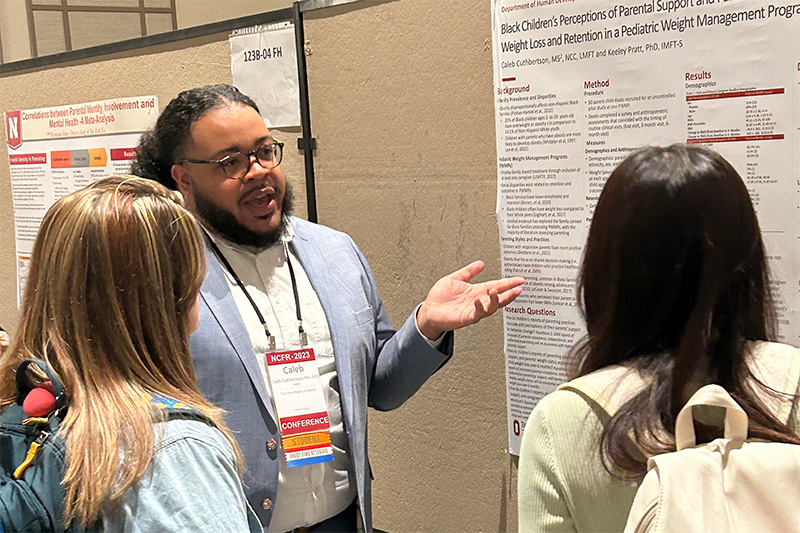
Experts with the Regional Gun Violence Research Consortium (RGVRC) address different facets of firearm violence from a variety of perspectives and disciplines. In this new series, get to know our experts and learn more about their contributions to better understand, prevent, and respond to the public health crisis of firearm violence. Get to know Caleb Cuthbertson, the RGVRC’s new postdoctoral research fellow.
Why do you study gun violence? Why is this an important area of research and how do you see your work helping to address this issue?
I study gun violence because, for me, it is personal. My family was directly impacted by gun violence in 2016 when my cousin, who was raised more like a brother because we’re the same age, survived 7 gunshot wounds, one week before his 21st birthday. This was an experience that I suppressed until I started my clinical training during my graduate education. For my master’s in rehabilitation mental health counseling from North Carolina Agricultural and Technical State University, I completed my internship at the Addiction Research and Clinical Health (ARCH) Program at Atrium Health Wake Forest Baptist Center. Through this internship, I was afforded the opportunity to provide counseling services to survivors of traumatic, often violent, injuries. To my surprise, I was able to connect with the survivors of firearm injuries (and their families!) on a deeper level. Initially, I didn’t understand this therapeutic rapport, but then I finally realized that I once was the family member supporting a survivor. This internship recalled my lived experience and inspired my research.
We hear all that time that “gun violence is a(n) ______ issue.” As a family scientist, this remains true for our field: gun violence IS a family issue. My research examines how non-fatal gun violence impacts the mental health and functioning of family systems. As a family member of a survivor of a firearm injury, I understand that the effects of gun violence extend beyond the individual who was physically injured, often reverberating throughout the entire family system. Yet, there remains a significant gap in the literature examining the mental health experiences of survivors and their families. My research seeks to center the stories of families as they navigate their mental health, coping, and relational dynamics following a firearm injury.
What is your research focus related to gun violence? What are you currently researching?
My research related to gun violence examines the psychological and relational impact of firearm injuries on families. There is evidence that survivors of firearm injuries and their family members have similar negative mental health consequences following the injury. As such, my research explores the interdependent relationship of mental health outcomes for families. I recently completed my dissertation, which was a dyadic narrative inquiry. I interviewed a gun violence survivor and a family member who provided support through their recovery, exploring the mental health symptoms and relational impact of firearm injuries. Building on this work, I plan to continue expanding this study to better understand how families collectively experience, adapt to, and recover from firearm-related trauma.
As I transition into my role as a postdoctoral research fellow, I am looking forward to contributing to ongoing projects at the RGVRC but also advancing my research agenda through the exploration of how policy influences the psychological support and resources received by families impacted by firearm injuries. I am particularly interested in how hospital violence intervention programs (HVIPs) and other community organizations engage and support the needs of families. I hope to examine the acceptability of and satisfaction with services provided by family members. This foundational research will influence my career goal, to develop a family-based intervention for firearm injuries.
What do you hope that people can take away from the research you are conducting?
I hope that the experiences of families will be brought to the forefront through their shared narratives. Gun violence is not an isolated experience. Family members are also impacted by firearm injuries, despite not sustaining the actual physical wound. Through my research, I hope that researchers, clinicians, policymakers, and communities will broaden how they understand the impact of firearm injuries and recognize family members as an important part of both the experience and the recovery process. This means moving beyond an individual-centered approach to consider how families cope, communicate, support one another, and heal collectively. Ultimately, I hope this research contributes to interventions, policies, and systems of care that not only address the needs of survivors but intentionally assesses and supports the psychological and relational needs of the entire family. If we understand gun violence as something that affects family systems, we can also broaden our impact on healing.
Learn more about Caleb and his work for the Regional Gun Violence Research Consortium below.