
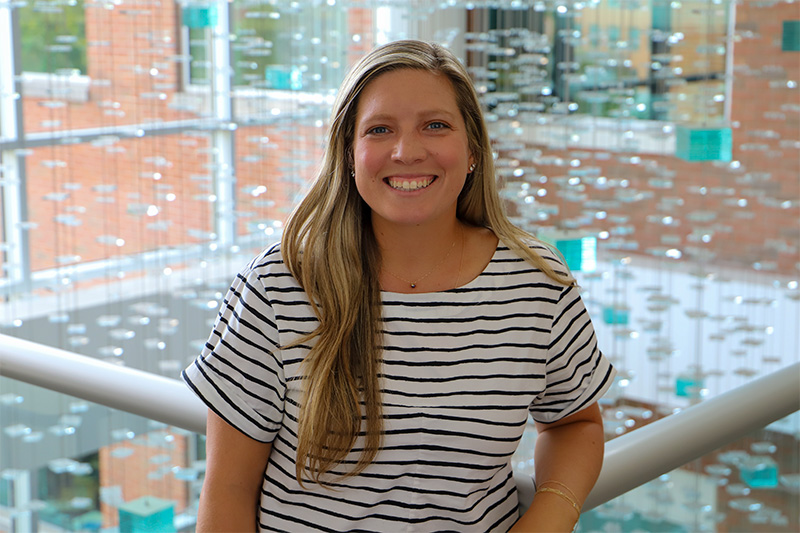
Experts with the Regional Gun Violence Research Consortium (RGVRC) address different facets of firearm violence from a variety of perspectives and disciplines. In this new series, get to know our experts and learn more about their contributions to better understand, prevent, and respond to the public health crisis of firearm violence. Get to know Allie Bond, a scholar with the RGVRC and the New Jersey Gun Violence Research Center and an Assistant Professor in the Department of Urban-Global Public Health at Rutgers University.
Why do you study gun violence? Why is this an important area of research, and how do you see your work helping to address this issue?
I come from the suicide prevention research world, and I moved into studying gun violence because firearms account for about 50 percent of all suicide deaths, and suicide accounts for about 60 percent of all gun deaths—and we really can’t talk about preventing suicide without talking about preventing gun violence. And so I found myself here, in the gun violence space, because I truly believe that the way for us to reduce suicide rates and save lives is through gun violence research.
My goal for the research I do is to do just that: advance the field of firearm suicide prevention in a way that has a tangible impact. To make sure the work actually has an impact, I dedicate time to science communication—writing blogs, giving community talks, making infographics—to make sure that the work I do is disseminated beyond the walls of academia and to communities most impacted by firearm suicides.
What is your research focus related to gun violence? What are you currently researching?
My research predominantly falls into two lanes. The first is identifying who dies by firearm suicide and where they interact—especially with healthcare—prior to death. The goal is to figure out who is most at risk for firearm suicide and where we could put interventions in place, actually, to reach those most at risk. For example, a paper I wrote a few years ago found that the vast majority of those who die by firearm suicide do not interact with mental healthcare prior to death, and so we need to find other avenues through which to screen for firearm access and discuss lethal means safety for those most at risk. My second line of work is focused on ways to increase secure firearm storage for suicide prevention, through credible messengers, screening, and lethal means counseling in healthcare, and creating or adapting interventions or resources that promote secure storage.
What do you hope that people can take away from the research you are conducting?
The first thing I hope people can learn from me is that, for grad students and other trainees thinking of getting involved in their field, you can do it. I feel like my research has had a real impact on the field, and others can too.
Next, that mental healthcare (as much as this pains me to say as a psychologist) isn’t going to be where we reach the vast majority of those at highest risk for firearm suicide; we need to be creative and find trusted channels outside of mental healthcare that can help promote secure storage and reduce firearm suicides.
Learn more about Allie and her work for the Regional Gun Violence Research Consortium below.