
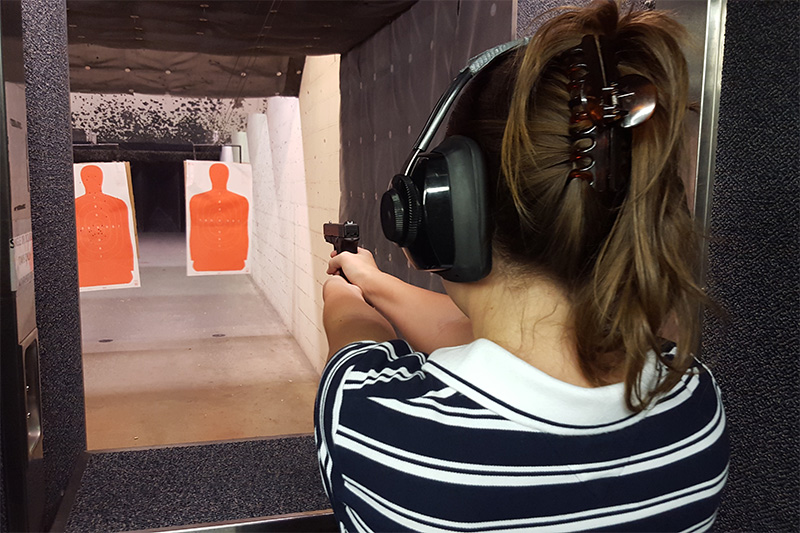
Debates and discussions around firearms often center on the ideas and experiences of men. In America, Pew Research Center and Gallup surveys indicate that approximately 30 percent of Americans personally own a firearm, yet far greater shares of men than women report personal gun ownership (e.g., 40 percent of men vs. 25 percent of women, according to Pew’s data, and 43 percent of men vs. 20 percent of women, according to Gallup). However, recent surveys also show the gender gap in firearm ownership has been narrowing. While a masculinity-oriented lens often frames firearm ownership in terms of identity and symbolism, emerging research (such as our work, which we discuss below) suggests that women’s gun ownership may be better understood through care and responsibility frameworks.
The spike in gun sales occurring during the COVID-19 pandemic in 2020, where an estimated 7.5 million US adults became new gun owners, really sparked attention to women gun owners. Those same data (the 2021 National Firearms Survey) revealed that about half of these new pandemic gun owners were women. News media reported at the time that the demographics of America’s new gun owners represented a significant shift away from the stereotypical older, White, male, conservative gun owner. This shift has been characterized by stakeholder groups in at least a few ways. For example, in an opinion piece at The Hill, Beth Alcazar, editor-at-large for the US Concealed Carry Association, described women as leading a “quiet revolution happening in the world of gun ownership in America.” The website for A Girl & A Gun, a women’s-only shooting club, notes that women today approach firearms “from necessity rather than tradition,” a perspective perhaps reflective of women’s increased risk of firearm-involved intimate partner violence. Testimonials posted on the website of the Armed Women of America (AWA) nonprofit—which has chapters across the US— are dominated by themes of empowerment and confidence.
But, given these shifts, how do women think about and engage with firearms in their everyday lives? We approached this question as social scientists, curious about how expectations—particularly around protection—may drive this “quiet revolution” among American gun owners.
In a paper published in Social Science Quarterly in late 2024, we (Sola and Warner) drew on sociologist Jennifer Carlson’s discussion of the “provider to protector shift,” which describes how, in the face of declining opportunities to provide for one’s family financially (i.e., as breadwinners), some men utilize gun ownership to shift from an identity stressing providing to one stressing protection. The widespread economic impact of the COVID-19 pandemic provided a way to test gender differences in the association between financial distress and people’s desire for guns. Financial distress is deeply unsettling—it undermines our fundamental drive to view the world as orderly and predictable, and to feel in control of our fate. Acquiring a firearm, then, can be one method for regaining a sense of safety, control, and belonging, something that social psychologist Nicholas Buttrick outlines in his “Coping Model of Protective Gun Ownership.”
We found that financial distress increased handgun desirability mainly among women, especially unmarried mothers, but not among men.
Using data from a survey of over 8,000 American adults recruited in May 2020, we tested the assumption that men, especially men in family provider roles (as spouses and parents), might express a greater desire for firearms if they had just experienced pandemic-related financial stressors, such as losing a job or having a reduction in work hours. While we initially approached this project interested in men’s firearm attitudes, our preliminary analyses revealed far greater variation among women, especially mothers. To inform our theorizing about how and why women’s firearm interest may be especially responsive to financial stressors, we revisited early 2000s discourse around “security moms,” politicized discourse positioning the family as under attack, and more recent work highlighting how women frame their firearm ownership as empowering.
We found that financial distress increased handgun desirability mainly among women, especially unmarried mothers, but not among men. In our study, when shown a picture of a handgun, financially stressed individuals rated that firearm as more desirable than their unstressed counterparts. Yet, we saw that men’s handgun desirability was steady. Men desired handguns but were no more or less favorable towards them when financially distressed or when occupying a social status—“provider”—that is highly shaped by social norms of masculine protection. Instead, it was women in our sample driving the main effect of financial stress on gun desirability. The effect was greatest among unmarried mothers—their pandemic-related financial distress spurred levels of interest in handguns that were similar to the high levels of interest across all groups of men in the study. The patterns we observed aligned with the sentiment expressed by one gun-owning mother quoted in The Washington Post in 2022, who explained her decision to buy a gun by stating, “…so many parts of my life felt out of control…but I could control one thing—and the most important thing—protecting my family.”
These findings also aligned with the experiences of women featured in my (Kelley’s) recent book, A Gun of Her Own: The Everyday Lives of Women Who Shoot. While the survey work demonstrated a population-level pattern in women’s firearm interest, the interviews illuminate how women gun owners themselves narrate responsibility, safety, and protection.
In the book, I explore women’s motivations for gun ownership and how firearms become integrated into their everyday lives. Drawing on in-depth interviews with gun-owning women across the Midwest from a wide range of political, economic, and social backgrounds, I focused on how women understand responsibility, safety, and protection in their families and communities. The women who shared their stories rarely understood gun ownership as part of their identity. Instead, they described firearms as practical tools embedded within broader responsibilities of care and protection. A significant number of women spoke about what sociologists call altruistic fear—concern for the safety of family members, friends, and others in their community—which often motivated their decision to own a gun.
As one woman explained: ”Having a gun means taking responsibility for what could happen. That’s why I train, I want to know I could protect my family if I had to.”
Cultural narratives often frame men as protectors, yet many women experience protection as an everyday responsibility woven into the routines of caring for family and community. Psychologist Carol Gilligan describes an ethic of care that exists because women’s socialization and moral development so often emphasize relationships, responsibility, and attentiveness to others rather than autonomy alone. Within this orientation, women’s firearm ownership carried with it a sense of duty: a duty to protect, but also to be prudent and prepared. Many women described investing significant time in training, practice, and learning safe handling because they felt responsible for the consequences of owning and carrying a firearm, a finding that matches prior work showing higher safety planning among women gun owners compared to men gun owners. I (Kelley) describe this pattern as a care mindset—an approach to gun ownership grounded less in identity or symbolism and more in vigilance, responsibility, and the everyday work of looking after others. As one woman explained: ”Having a gun means taking responsibility for what could happen. That’s why I train, I want to know I could protect my family if I had to.” Within this orientation, protection is not simply a symbolic role.
Public conversations around guns too often conflate gun ownership with gun violence, or these conversations center the perspectives of men, speak to stereotypes, or ignore gender altogether. We argue for—and believe our studies support—the importance of including the unique perspectives of women (especially mothers) in discussions around gun ownership, use, safety, and harm. Taking women’s care-centered approach to firearms seriously may not resolve the nation’s gun debates, but it reveals perspectives that have too often been missing from the conversation. At a minimum, attention to the care mindset may be helpful for shifting policymakers toward emphasizing, normalizing, supporting, and facilitating access to both training and practice in firearm safety and handling. Capitalizing on the duty to protect others could be key for encouraging widespread engagement in the firearm safety practices that we know are essential for reducing and preventing firearm-related harms.
ABOUT THE AUTHOR(S)
Justin Sola is an assistant professor in the Department of Sociology and School of Data Science and Society at the University of North Carolina at Chapel Hill.
Margaret Kelley is a professor of American studies at the University of Kansas.
Tara Warner is a professor of criminal justice at the University of Alabama at Birmingham.
All are affiliate scholars with the RGVRC.