
Across the United States, state lawmakers are grappling with how—or whether—to regulate kratom, a plant-derived substance sold widely as powders, capsules, energy drinks, vapes, herbal supplements, and gummies in smoke shops, convenience stores, and online marketplaces. Kratom leaves contain two compounds, mitragynine and 7-hydromitragynine (7-OH), that can have opioid-like effects in higher doses. Because of these effects and the ease with which the product can be purchased in retail settings, kratom has sometimes been referred to as “gas station heroin.” As concerns over the use of kratom continue to rise across the nation, the landscape of kratom policy has been evolving rapidly. In just the last few weeks alone, Connecticut has banned the substance by adding it to the state schedule of controlled substances, a bill in Kansas that would schedule Kratom as a Schedule I drug has passed both chambers of the state legislature and was sent to the governor for signature, Utah replaced its Kratom Regulation Act with stricter regulations, and effective April 1, 2026, Rhode Island’s ban on kratom was reversed by legislation enacted last year under which the substance is regulated for sale and an excise tax is implemented.
A previous blog examined the kratom legislation that states have already passed and implemented. This blog will update recent legislative developments as well as look at the trends among the bills that are currently being considered in state legislatures across the country.
View the Kratom Policy Dashboard
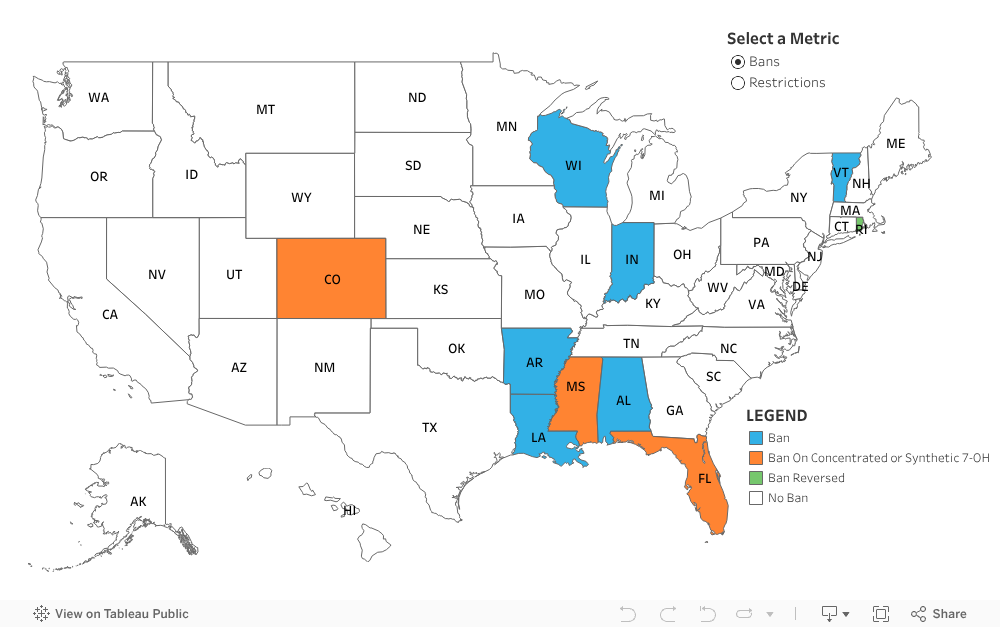
A maintained version of the map below is available on our Kratom Policy Dashboard, which monitors how states across the US are responding to growing policy and public health concerns surrounding kratom and its active alkaloid 7-hydroxymitragynine (7-OH).
Legislation Introduced
Almost every state in the nation introduced some form of legislation regarding the status of kratom in its respective jurisdictions. These bills vary from state to state in their details, but most of the proposed legislation tends to fall into three broad categories: bans on kratom, scheduling kratom or 7-OH through respective state-controlled substances acts, or regulation of the sale, manufacturing, and distribution of kratom through some version of a kratom consumer protection act. These three buckets capture almost all the kratom-related bills that were under consideration in the 2025–26 state legislative sessions. It is worth noting that states have generally considered several bills related to kratom in a single legislative session that offer different approaches to address the rising use of kratom and kratom-related products. What path forward, if any, that a state chooses to pursue is still a pending matter in many states.
Bans
Banning kratom is an option that several states are actively considering; this type of legislation would make the sale, possession, or manufacturing of kratom illegal throughout the state. States like Wisconsin, Indiana, Alabama, and Vermont had previously banned kratom, while states like Colorado and Mississippi had banned concentrated or synthetic 7-OH, allowing for the natural kratom leaf to continue to be sold.
More recently, bills were introduced this 2025–26 legislative session in states like Delaware, Illinois, Michigan, South Dakota, and Tennessee that would prohibit kratom and kratom products within their boundaries. Though the legislature is considering more permanent solutions, Ohio has enacted an emergency rule, expiring in June 2026, that bans synthetic kratom products. Kratom bans have also been the most frequent tool employed by localities, such as Albuquerque (NM), Kansas City (MO), Nassau County (NY), and Spokane (WA), to try to limit the presence of kratom in their communities.
Scheduling
A variation on a ban is the decision to add kratom or one of its primary compounds, 7-OH, to a state’s controlled substances schedule. While the federal government has floated the idea of scheduling 7-OH without any additional concrete action, states have been scheduling kratom much more quickly. These schedules mimic the federal controlled substances schedule that was created by the Controlled Substances Act of 1970, where substances are scheduled depending on their medical usefulness and potential for addiction or abuse. Drugs that are categorized as Schedule I are determined to be the most dangerous, with the medical benefits, if any, outweighed by the potential for abuse or death. This effectively criminalizes their manufacture, sale, or possession. Similar scheduling bills have been introduced this session in states like Idaho, Iowa, Georgia, Nebraska, New York, North Carolina, Pennsylvania, and Texas. While most of the scheduling would categorize kratom or 7-OH in Schedule I, there are exceptions. Illinois, for example, has legislation under consideration that would make mitragynine and 7-OH Schedule III, which would restrict rather than outright ban the substances.
It is also important to note, however, that there is one state where the scheduling of 7-OH is likely to be reversed. Florida implemented their scheduling of 7-OH concentrated at a level of 1 percent by an August 2025 emergency order by the attorney general, not legislative action, and that ban is set to expire June 30, 2026. Though several kratom bills were considered this session by the Florida legislature, their session ended in March without any of the pending bills being passed that would have maintained the status of 7-OH. The scheduling and ban, therefore, may lapse.
Kratom Consumer Protection Acts
The largest number of kratom bills that have been introduced this legislative session do not look to ban or schedule the substance, but instead add regulations for how kratom and kratom-related products can be made and sold in the state. These kratom consumer protection acts dictate how the product is made, how it is marketed, and who is eligible to purchase. The acts are often based on model legislation that is supported by the kratom industry; though there is some variation, most of these acts contain the same basic components:
- Age restrictions. Limiting the purchase of kratom products to those either 18 years or older or, more commonly, 21 years or older.
- Testing requirements. Requiring that, before products go to market, they are evaluated by an independent laboratory to confirm their contents.
- Concentration limits. Setting a limit—usually around 2 percent—of how much 7-OH can be present in the product.
- Prohibitions of kratom products that can be vaped or are otherwise combustible.
- Prohibitions of packaging, advertising, and product appearance that would be attractive to children.
- Registration, licensing, or permitting. Requires some form of approval by the state to sell kratom products or a tracking system for kratom products approved for market.
- Restrictions on kratom products that are mixed or packed with non-kratom or other controlled substances.
- Labeling. All kratom products must contain a label that meets the requirements outlined in a respective state’s legislation. This is where the most variation can be found in what is required by individual states; bills have included provisions for some or all of the following:
- ingredients and manufacturer information;
- alkaloid content and purity;
- directions for use, including suggested serving size and number of servings that are safe to consume in a 24-hour period; and
- warnings, including disclaimers that the product is not approved by the US Food and Drug Administration (FDA), potential health risks associated with use, and reiteration of age restrictions.
Some variations of these kratom consumer protection acts have been introduced this session in states like Hawaii, Idaho, Illinois, Massachusetts, Maryland, Michigan, Ohio, Pennsylvania, Washington, and Wyoming. Similar legislation was passed this session in Nebraska.
These competing approaches reflect a broader national debate. Some policymakers and public health officials warn that kratom carries risks of addiction, contamination, and adverse health effects, while some advocates argue that regulated access can provide an alternative for people seeking relief from pain or opioid dependence. As a result, legislatures are increasingly faced with a choice between prohibition and regulation, which has produced a rapidly evolving and often confusing policy landscape. As legislative sessions conclude, the policymaking trends may become clearer. It is one thing to introduce a bill and quite another to garner the support needed for that bill to be passed into law. With current federal inactivity on the issue of kratom regulation, the states have become the primary policymakers, and for those states looking to act on kratom, three primary policy preferences have emerged: ban, schedule as a controlled substance, or create a commercial market with limitations and regulations. The Rockefeller Institute will continue to monitor the kratom policy landscape as it evolves.
ABOUT THE AUTHOR(S)
Heather Trela is director of operations and fellow at the Rockefeller Institute of Government