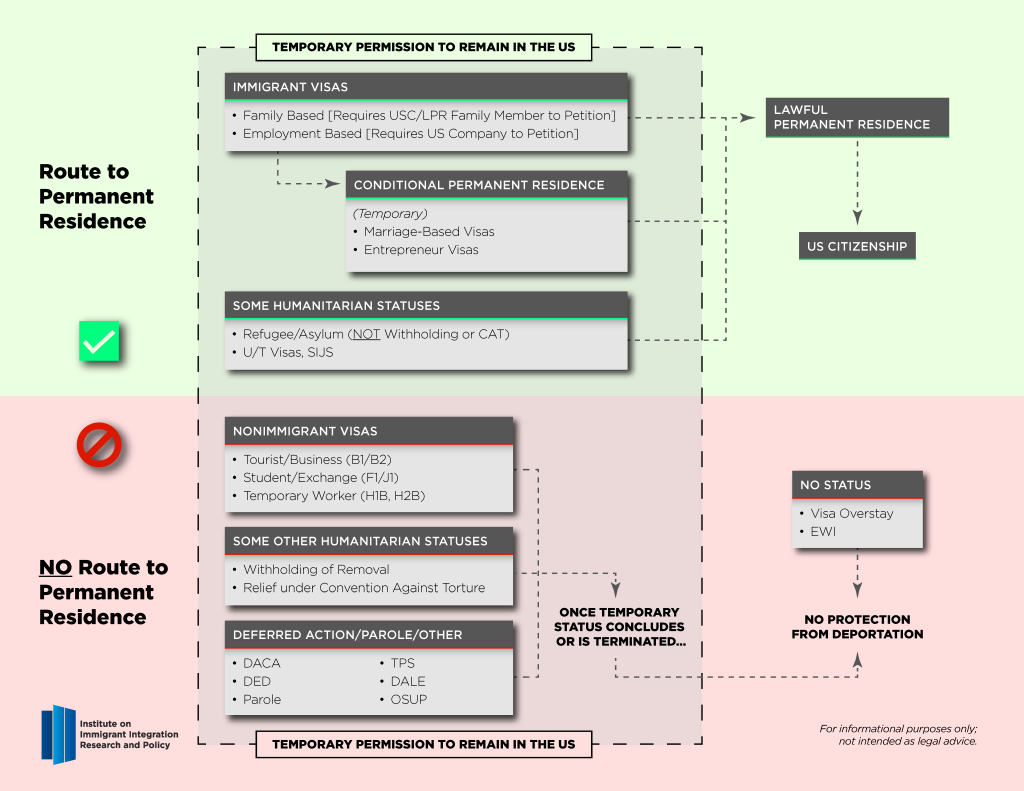
This fact sheet from the Institute on Immigrant Integration Research and Policy provides a quick reference to some more common immigration statuses. This fact sheet is for informational purposes only; it is not intended as legal advice. Special thanks to Lauren DesRosiers, assistant professor of law and director of the Immigration Law Clinic at Albany Law School, and Sarah Rogerson, distinguished professor of law and director of The Edward P. Swyer Justice Center at Albany Law School. Compiled August 2025.
US Citizenship & Nationality
US citizenship is acquired through birth (anyone born in US state or territory, or, if born abroad, may be inherited through US citizen parents under some circumstances) or adoption (under some circumstances).
US citizenship may be acquired through naturalization. [LPR is prerequisite to naturalization.]
Individuals born in any US state or territory acquire US citizenship at birth, EXCEPT American Samoa. Birth in American Samoa does not confer US citizenship, only US nationality.
Lawful Permanent Residence (“Green Card,” “Adjustment of Status”)
Eligibility to apply for Lawful Permanent Residency generally requires prior or simultaneous acquisition of an immigrant visa, qualifying relationship (such as marriage), or other separately acquired status (such as asylum) that renders them eligible to “adjust status.” Individuals in visa/status categories that are not eligible for LPR may be able transition to another status they are eligible for that does provide path to LPR.
- Immigrant Visas [Eligible for LPR]
- Employment-Based Visas: US employers may petition for some foreign workers.
- Family-Based Visas: USCs/LPRs may petition for some close family members.
- Some Humanitarian Statuses [Some Eligible for LPR]
- Refugee status/Asylum: Eligible to apply for LPR 1 year after admission.
- U/T Visa: May be eligible to apply for LPR during limited window after visa grant.
- SIJ: Eligible to apply for LPR when visa available per DOS Visa Bulletin.
- Conditional Permanent Residence (Limited PR)
- Green cards through marriage & entrepreneurship receive 2-year “Conditional Permanent Residence” (CPR). Must apply to remove conditions to receive full LPR.
- VAWA provides alternative routes for individuals with family-based petitions who are abused by the petitioning family member. This allows the applicant to proceed with pursuing immigration status without needing the assistance of abusive US petitioner.
Non-Immigrant Visas [Not Eligible for LPR]
- Tourist/Business Visa (B1/B2): Short term temporary visas for brief visits.
- Student/Exchange Visa (F1/J1): Temporary visas with strict limits on activities and work.
- Temporary Work Visa (H1-B, H2-B): Temporary work visas, limited term and/or seasonal. (High risk of exploitation of vulnerable workers.)
Humanitarian Relief [Some Eligible for LPR]
- Refugee Status/Asylum: Refugee process is administered by UNHCR outside of the United States; applicants for asylum apply within the US; both must meet the definition of “refugee” under UN Convention. Can apply for LPR 1 year after admission to US as refugee (on entry to US) or asylee (on grant of asylum).
- Withholding of Removal/CAT (Convention Against Torture): Similar to asylum, withholding and CAT relief may be available to people who don’t meet all the elements of asylum. They do NOT provide avenue to LPR.
- U/T Visas: Individuals who are victims of some serious crimes (U Visa) or labor/sex trafficking (T visa) and cooperate with law enforcement may be eligible to apply for U/T “nonimmigrant” visa. Despite being termed “nonimmigrant,” some recipients of U/T visas may apply for LPR.
- SIJS (Special Immigrant Juvenile Status): Unaccompanied children who have been abused, abandoned, or neglected by one or both parents may be able to apply for SIJ; when a visa becomes available, they may apply LPR.
- SIV (Special Immigrant Visa): Available to some individuals who assisted US efforts in Iraq & Afghanistan.
Prosecutorial Discretion/Deferred Action/Nonenforcement [Not Eligible for LPR]
- DACA (Deferred Action for Childhood Arrivals): Permits some people brought to the US as children to obtain work authorization and deferral of removal.
- TPS (Temporary Protected Status): Short-term permission for individuals from designated countries experiencing severe violence/war to register for limited protection from removal and work authorization.
- DED (Deferred Enforcement Departure): Defers deportation of individuals from some countries. (Similar to TPS.)
- DALE (Deferred Action for Labor Enforcement): Individuals assisting labor & employment agencies with ongoing investigations into labor violations can be eligible to register for limited protection from deportation and work authorization.
- Parole: Permitted to enter and remain in United States for set period of time. May be eligible for work authorization and other benefits through various parole programs
- OSUP (Order of Supervision): Under some circumstances, individuals that ICE has not removed within 90 days of final order of removal may be released from ICE detention under an Order of Supervision.
No Status [Not Eligible for LPR]
- Visa Overstay: Entered US through port of entry but overstayed permitted time.
- Entry Without Inspection (EWI): Entered between ports of entry and have not subsequently been apprehended or acquired other status.
In some circumstances, pending applications for some immigration benefits/relief may prevent removal during the pendency of the application and may prevent accrual of unlawful presence under the INA.