
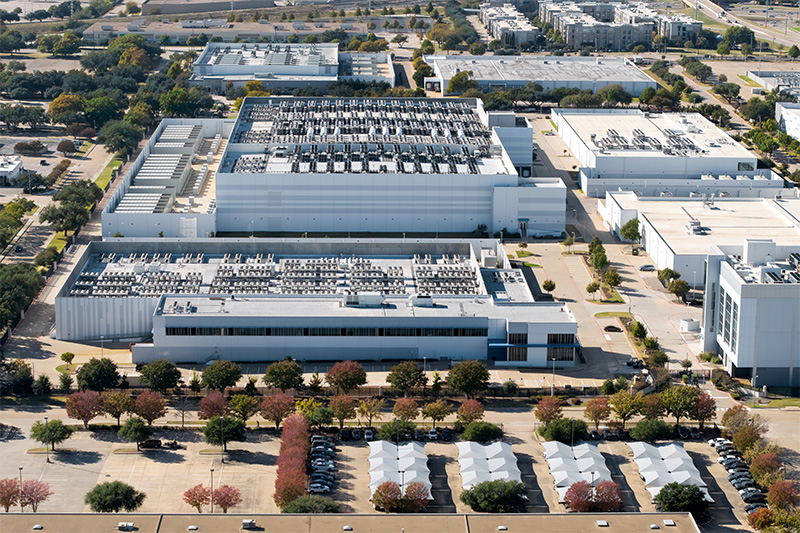
Our May 2026 policy brief, “Clouds, Cables, and Megawatts,” explored how states and local governments are responding to the current expansion of data centers. Since its publication, there have been important developments in this quickly evolving landscape. This blog outlines some very recent state-level legislative actions related to moratoriums for data centers and examines the continued rise of and opposition to proposed data centers in New York State.
State Moratoriums on Data Centers
As our previous policy brief stated, researchers and environmental advocates have raised concerns about data centers’ energy and water usage, noise, and air pollution. These concerns are most associated with hyperscale data centers, which have at least 5,000 servers—the type of data center that is more frequently being proposed as the demand for AI continues to grow. As policymakers and the public have become more aware of these concerns, more states have considered restrictions on their development. As of June 2026, 14 states have considered or are considering a moratorium on data centers, meaning a temporary pause on their construction.
Our earlier brief noted that Maine’s state legislature was the first to pass a moratorium (LD 307) on data centers—more specifically, on those rated for more than 20 megawatts until November 2027. However, on April 24, 2026, Governor Janet Mills vetoed the bill, stating that she supports a temporary moratorium and would have signed the bill if it included an exemption for the ongoing development already occurring at the site of the former Androscoggin Mill in the Town of Jay.
Our brief also described moratorium efforts in New York, Maryland, Virginia, Georgia, South Dakota, and Oklahoma; since then, eight more states have proposed moratoriums. The table below outlines these legislative efforts and provides an update on the current status of each.
State Moratoriums on Data Centers
| State and Bill | Brief Description | Data Center Size or Definition | Status as of June 8, 2026 |
|---|---|---|---|
| Georgia (HB 1059) | Prohibits local governments from permitting data centers until December 2028. | No size specified | Introduced |
| Maine (LD 307) | Moratorium on data centers until November 2027. | 20 Megawatts (MW) | Vetoed |
| Maryland (HB 120) | Prohibits data center construction and permitting. | No size specified | Introduced |
| Michigan (HB 5594/HB 5595) | Prohibits local governments and the public service commission from permitting or approving data centers until April 2027. | No size specified | Introduced |
| Minnesota (HB 4888/SB 4298) | Prohibits approval of new data center permits until the Public Utility Commission submits a comprehensive report, until at least July 2027. | 100 MW | Introduced |
| New Hampshire (HB 1265) | Moratorium on data center construction for one year. | No size specified | Introduced |
| New York (AB 10141/SB 9144) | A one-year moratorium on new data centers and requires the Public Utility Commission to draft new rules. | 20 MW | Passed by the Legislature; awaiting response from Governor Hochul |
| Oklahoma (SB 1488) | Prohibits data center construction until November 2029. | 100 MW | Introduced |
| Virginia (HB 1515) | Moratorium on new data centers until all interconnection requests are fulfilled or until July 2028. | 1 MW | Introduced |
| Pennsylvania (HB 2533) | Places a three-year moratorium on new “high impact” data centers, mandates new studies, and authorizes municipalities to prohibit data centers. | 25 MW | Introduced |
| South Carolina (H 5526) | Prohibits local approval of data centers until the Legislature adopts a “comprehensive oversight framework.” | 5 MW | Introduced |
| South Dakota (SB 232) | Moratorium on new construction or expansion of hyperscale data center until June 30, 2027. | 50 MW | Introduced |
| Vermont (S 205) | Requires an impact study and creates a moratorium on the siting and construction of AI data centers until 2030. | 100 MW | Introduced |
| Wisconsin (SB 1061/AB 1099) | Prohibits data center operation until certain conditions are met. | 100 MW | Introduced |
While most of these proposed moratoria take similar approaches—particularly in proposing temporary pauses in development while further detailed impact studies are performed—significant variation exists in how each proposal defines the size of data centers that are subject to a moratorium. For example, Oklahoma, Minnesota, Vermont, and Wisconsin place a moratorium on those of 100 MW or more. Other states are more restrictive, such as South Dakota, restricting those of 50 MW, New York, 20 MW; South Carolina, 5 MW; and Virginia, 1 MW. Additionally, most of these proposed restrictions target new construction, except in the case of Wisconsin, which prohibits the operation of current data centers.
Included in those legislative proposals was New York’s AB 10141/SB 9144. On June 4, 2026, the New York State Legislature passed a one-year moratorium, and the action is currently awaiting a response from Governor Kathy Hochul. The original bill included a three-year pause on the development of data centers, but this was amended and reduced to a one-year pause on the siting, construction, or commencement of operations of data centers. Along with this pause, the legislation also requires a broader environmental impact report that includes a study, and regulatory and legislative recommendations regarding data centers. More specifically, this report, authored by the Department of Environmental Conservation, would examine how many data centers are currently in operation in the state, the current and maximum GW capacity of existing data centers, and the number of active proposals for new data centers. Additionally, the report would examine data centers’ electricity consumption, including the source of their electricity, and the impact of data center development on monthly electricity and gas rates. The report must also detail water consumption and discharge by data centers, including the amount of water used for cooling systems, and the source of this water. The final report is due no sooner than 18 months after this legislation is enacted into law. While the passage of this legislation may be welcome news for environmental advocates who have concerns about the development of new large-scale data centers, industry representatives have stated that they are concerned that a moratorium could send a message to data centers that they are not welcome in the state.
Local Moratoriums
We also highlighted in our earlier brief that several local governments have approved moratoriums to prohibit the construction of data centers. More specifically, communities like Groton, Connecticut, Peculiar, Missouri, and Bangor, Maine, have successfully enacted their own moratoriums or bans. We’re seeing this trend continue nationwide, including within New York State.
On May 7, 2026, the Lysander Town Board in Onondaga County, near Syracuse, approved a six-month moratorium prohibiting the development and construction of new data centers. This moratorium was approved unanimously during the town’s regular monthly board meeting. At this meeting, more than 350 residents attended and shared their opposition to the proposed Ranalli Lysander Data Center, which is expected to have a 300 MW capacity on a 120-acre campus. Additionally, on June 4, 2025, the Town of Perth, in Fulton County, passed a one-year moratorium on the development of any data centers. The Perth Town Supervisor, Greg Fagan, cited concerns over energy usage and a desire to maintain local control.
St. Lawrence County stopped short of passing a moratorium on June 1, 2026, and instead passed a resolution affirming local authority over data center siting and urging all municipalities in St. Lawrence County to consider establishing moratoriums.
Recent Proposed Projects in New York
There have been more data centers proposed in New York State since our May 2026 brief, and previously planned centers have generated more opposition.
In the Town of Tonawanda, in Erie County, developer Riverview Innovation & Technology Campus is planning to use the former Tonawanda Coke Corp. industrial site to create a $2 billion, 500,000 square foot data center projected to use 300 MW of electricity. In a public meeting on June 3, hundreds of residents attended and spoke out about the project, citing concerns about environmental pollution, increased utility costs, community characteristics, impacts to property values, and noise pollution. One local resident shared their concerns, stating, “Clay was poured over toxic waste in the Love Canal neighborhood in 1953 and continues to affect people today…If we build this plant in 2026, how many years will the negative effects reach our friends, our family, generations to come? How many people is this going to affect and how many people does it need to affect for this plant to be a bad idea?” Other residents called for the state to enact a moratorium to gather enough information to see how similar projects impact host communities. In response to this meeting, State Assemblymember Bill Conrad, who represents the community, released a statement noting that he would cosponsor legislation to issue a moratorium on data centers. As of June 3, 2026, the data center’s application is currently “on hold” because of a stated backlog at the New York Independent System Operator, the public-benefit corporation that monitors and safeguards the electrical grid. Riverview Innovation & Technology Campus, the developer, has reiterated that it views this as a temporary delay and that they plan to continue to move forward with developing the center.
Another hyperscale data center has been proposed next to the former Alcoa East industrial site near Massena in St. Lawrence County. This proposed data center is projected to use 635 MW across three structures, the smallest of which is approximately 400,000 square feet, about twice the size of the nearest Walmart (the other two structures are 515,000 and 535,000 square feet). Concerns have been expressed about the 316 diesel generators causing noise and air pollution, along with power consumption and water usage questions. The project is currently being reviewed by Massena Planning Board.
There are also new plans for a 200 MW data center in the Village of Ilion, in Herkimer County, on the site of a large section of the former Remington Arms facility. Turin Hoefler Avenue LLC submitted a revised application to the New York State Department of Environmental Conservation (DEC) Brownfield Cleanup Program to clean up and construct a 250,000-square-foot AI data center. The developers state that this will be a “fossil-fuel free project” sourced with “the region’s clean energy resources” and will also include housing, open space for community use, and commercial uses. Developers also claim that they will create more than 274 higher-paying permanent jobs and more than 1,000 construction jobs across the whole project. As with other proposed data center projects elsewhere in the state, community members here have raised concerns during recent public meetings.
Consideration of yet another new proposal for a data center in New York has emerged, this one located at the site of the former Kenwood Convent and Doane Stuart School in Albany. Guild Ventures, the developer of the site, is reportedly applying to build a 180 MW data center as part of a mixed-use development that includes housing, green space, and retail. No permit applications had been submitted to the city as of the first week of June; however, further project details could be expected to be found. A spokesperson for Guild Ventures framed this project not as a hyperscale facility but as an “edge” data center aimed to serve local customers’ data needs. Regardless of this framing, there is public opposition to the project. Albany residents and advocates protested the project earlier this month, stating concerns over rising utility costs and questioning what community benefits the data center would provide.
State and local-level policy responses to data centers are likely to continue to spring up and evolve as plans for developing these new technology operations take root across the nation.
ABOUT THE AUTHOR(S)
Mathilda Scott is a policy analyst at the Rockefeller Institute of Government.