Over the last year, the Rockefeller Institute’s researchers, fellows, and partners have published, presented, and convened meaningful work on a broad range of issue areas with respect to public policy in New York State and across the nation as a whole. Saliently, their work has focused on key topics related to healthcare, disability, drug policy, education and workforce development, and environmental health and science policy. As in previous years, we invited Rockefeller Institute staff to write about their favorite pieces from this past year.
As we move into and begin to think about what’s next in 2026, we remain committed to focusing on the important public policy issues facing New York and other states. In many cases, this means working closely with government agencies and others involved in the policymaking process. Regardless of who we work with, the Institute’s research is so useful because it is conducted in an independent manner by analysts with an interest and expertise in many policy areas. Fortunately, our partners have always valued this independence and, as a result, the work we produce becomes even more valuable to both those in government and to the general public interested in the policy issues we address.
— Bob Megna, President
Here are the pieces they chose to highlight!
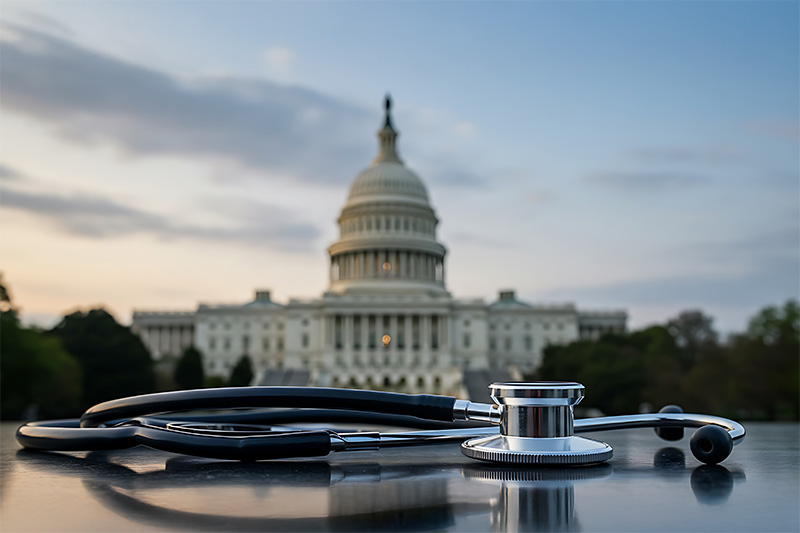
The Federal Shutdown—Healthcare Policy, State and Local Impacts
Laura Rabinow, Director of Research
Rockefeller’s research on the recent Federal shutdown—the underlying policies and programs at the heart of congressional budget negotiations, and the people potentially impacted by them—provided critical, timely analysis for policymakers. The work of the health policy team and their collaborators—including Courtney Burke, Jillian Kirby Bronner, and Troy Oechsner—served to outline not only the healthcare programs and funding that were at issue in negotiations, but the precipitating events and policies implemented through HR 1, and the significant projected impacts on New York State and its residents. Saliently, the ongoing work of these researchers looks at the continuing impacts of those events and policies with respect to the healthcare coverage that is available to New York’s residents, including certain vulnerable populations, as we move through the current open enrollment period (between November 1, 2025, and January 15, 2026). Likewise, local government expert fellow Lisa Parshall’s work this year highlighted the ways in which the shutdown could have more broadly impacted states and localities, and the hard fiscal decisions that would follow. Her work critically continues to monitor potential impacts in New York and elsewhere if and as the federal administration further shifts responsibility for certain areas of governance towards state and local governments.

Kratom—The Fractured Regulation of Unscheduled Drugs
Mathilda Scott, Policy Analyst
This year, our director of operations and fellow Heather Trela expanded her drug policy research to focus on the emerging challenges of kratom. Kratom, a drug that is derived from a tropical tree in Southeast Asia, acts like a stimulant in lower doses and an opioid in higher doses. Its usage has become more widespread in the United States over the last few years, with the American Kratom Association estimating between 11 and 16 million Americans using kratom products in the past year. Trela’s work importantly outlines how federal, state, and local regulations are creating a fractured regulatory system where there are no restrictions on the purchase of kratom in some communities, and in other communities, possession of kratom can result in criminal penalties. Her work further explores how kratom fits into larger challenges in drug policy as policymakers and health practitioners attempt to balance harm reduction, public health, and individual autonomy.

Lead Service Line Inventories in New York State
Maxwell Herrera, Policy Analyst
This year, our researchers also expanded on another area of public health policy at the intersection of environmental health with respect to lead service lines. Building on our earlier report regarding federal rulemaking requiring the identification and replacement of service lines—that connect individual homes or buildings into a water system—when they are made of lead or other potentially harmful materials. As part of its work monitoring the ongoing efforts by the state to comply with this federal rulemaking, authors Laura Rabinow, Mathilda Scott, and Austin Clark analyzed the initial inventory data for service lines reported by water systems across New York State. Their brief summarized the current state of this reported data, challenges to effectively completing service line inventories in the state, and related recommendations aimed at better ensuring New York is better able to protect public health and comply with federal requirements.

School District Regionalization
Leigh Wedenoja, Chief Economist
In view of significant recent cuts to Department of Education programs, it has become more important than ever for New York State to develop creative and efficient strategies to deliver education and related services to the state’s children. Director of Education Policy Studies Brian Backstrom’s school district regionalization series this year highlighted the potential to deliver education services in a more efficient and direct way, while potentially taking some of the pressure off individual school districts and extending services to more students. Backstrom’s work outlines ways in which the regionalization of some instructional, administrative, and operational services can allow districts, especially small districts, to take advantage of economies of scale and spend less per student for more services. The series not only examined the potential for regionalization of services generally, but for mental health and data administration specifically, and also featured some promising existing regionalization efforts in New York—bringing together both researchers and practitioners for a practical discussion of regionalization in New York.
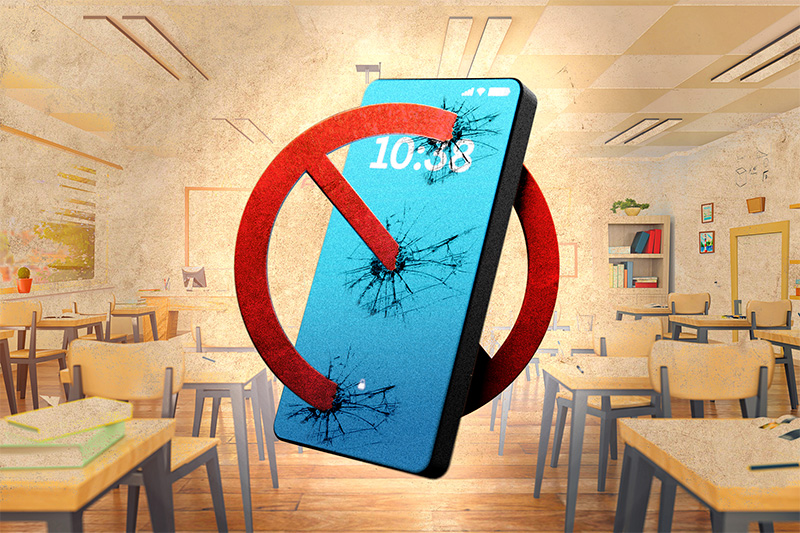
School Cell Phone Bans and Restrictions
Heather Trela, Director of Operations and Fellow
In addition to that critical education discussion, we delved into another timely policy area related to schools—cell phones. The central role that cell phones play in our daily lives is both a blessing and a curse—they are a useful resource for immediate information, but can also serve as a distraction, discourage human interaction, and open young people to other vulnerabilities. Perhaps, nowhere is that more obvious than in schools, where teachers and administrators have been weighing the pros and cons of cell phone usage during the school day. An increasing number of states, including New York, have come to the conclusion that the costs outweigh the benefits and have implemented cell phone bans for their school districts. This year, as districts across New York State implemented the statewide ban for the first time, Mathilda Scott examined the existing research on the effect of school cell phone usage and the current landscape of school cell phone restrictions, including how different states have crafted their respective policies.

New York State Science Policy Fellowship
Zan Strumfeld, Program Manager
All of the above research has worked to support and inform public policymakers and practitioners as they make critical decisions about how to best serve their constituents and New York’s residents as a whole. Such work underscores the need for further expertise to be brought to bear that can help bridge the frequent gaps in translation between research, policy, and practice. Bridging that gap and building translational capacity is the goal of the New York State Science Policy Fellowship (SPF), which began in August 2024 with generous support from the Simons Foundation and the Gordon and Betty Moore Foundation. This year was the program’s first full year and the first time we had two cohorts running simultaneously—for a total of 12 fellows in two-year placements, working in both legislative and executive placements. These placements include the New York State Energy Research & Development Authority (NYSERDA), the Department of Environmental Conservation (DEC), Empire State Development (ESD), the State Assembly, the State Senate, the New York State Attorney General’s Office Environmental Protection Bureau, and the New York State Office of Addiction Services and Supports (OASAS). We look forward to seeing their long careers in science policy continue to evolve through this program and add incredible expertise to New York’s public workforce!