
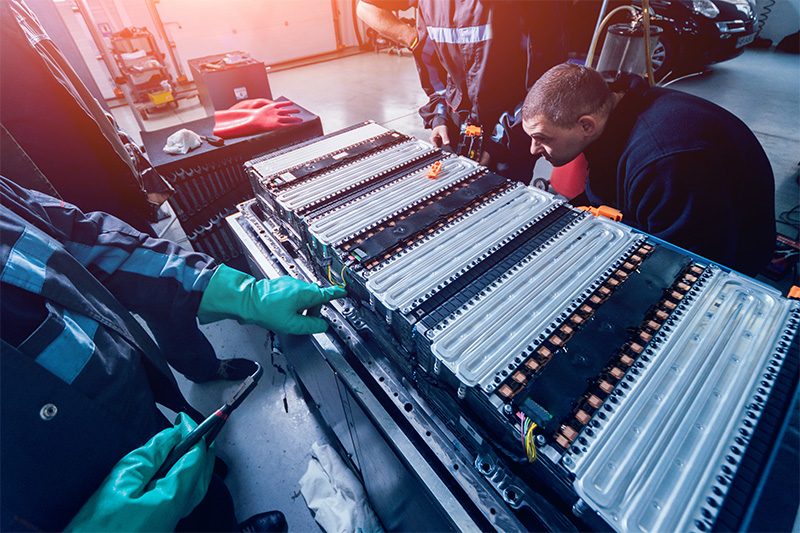
Prior federal and existing New York State policies1, 2 aimed at reducing carbon emissions have supported the further development of electric vehicle sales and have led to more production and purchasing of electric vehicles (EV) and plug-in hybrid vehicles (PHEV) in recent years. According to the Department of Energy, “annual sales of EVs more than quadrupled from 2020 to 2023,” with more than one million EV sales for the first time in 2023. Although EVs reduce air pollution and are an important component of addressing climate change, the production, recycling, and disposal of EV batteries also come with environmental health impacts and challenges. Recycling facilities and recycling and reuse markets are facing a number of uncertainties amid current federal policy changes.
Timeline of Federal Policy Changes & Related EV Impact
| 2021 |
Bipartisan Infrastructure Law (BIL)
|
| 2022 |
US Department of Energy
|
Inflation Reduction Act (IRA)
|
|
| 2023 |
Environmental Protection Agency (EPA)
|
| 2025 |
One Big Beautiful Bill Act (OBBBA)
|
What are EV Batteries Made Of?
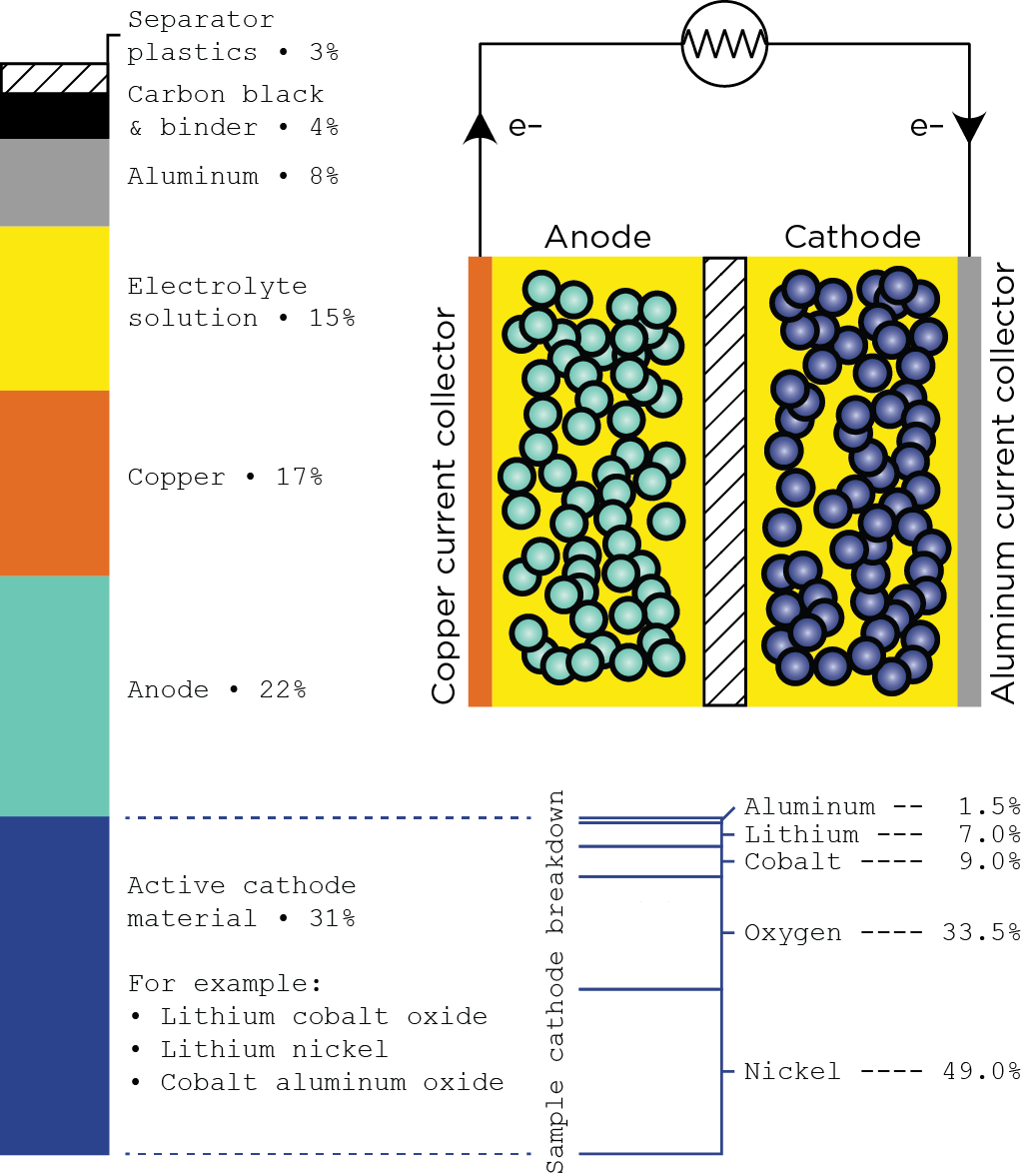
EV batteries are battery packs made up of multiple “modules” or identical parts that contain many electrochemical cells. These cells contain layers (anode, cathode, and separator layers) that are in contact with an electrolyte (typically a liquid), and those components are then stacked or rolled together in steel or aluminum, making up a cell. Different chemicals can be used in the cathode of batteries, but lithium nickel cobalt aluminum oxide chemistries are more frequently used in EV batteries due to their relatively high energy storage capacity to support propulsion, with lithium-ion batteries being the most common. There are, however, competing alternatives, including lead acid, nickel metal hydride, and others. Materials used for the manufacturing of EV batteries (if variably) tend to be costly and environmentally intensive to mine and refine. In addition to these chemistries, cells may contain other materials such as copper, plastics, manganese, and graphite. EV batteries drive a significant portion of the market for some of these materials. According to the International Energy Agency (IEA), “in 2022, about 60% of lithium, 30% of cobalt and 10% of nickel demand was for EV batteries.”
EV Battery Cell Composition
EV Battery End-of-Life Pathways
Typically, after their use in vehicles, EV batteries and their components follow three paths at their “end-of-life” (EOL): reuse, recycling, or disposal. EOL batteries from EV cars are typically identified for reuse or recycling by car manufacturers, dealerships, mechanics, or disassemblers, and are then sent to other collection, intermediate processing, and recycling facilities..
- Reuse—A battery is typically considered to have exceeded its useful automotive life, when its storage capacity is 80 percent or lower of its initial capacity. While it may not be sufficient for an EV, some are reused in “second life” applications like grid storage or home backup systems, and batteries can be tested and repaired to make sure they function adequately. This market is, however, still limited by relatively high testing and certification costs.
- Recycling—EV batteries that can no longer be reused may be recycled to recover valuable metals and materials to create further EV batteries. Estimates for the percent of EV batteries recycled, according to recent data from 2023, vary widely—from 5 percent (commonly cited) to 59 percent. Advanced methods can achieve up to 95–98 percent recovery of materials, though infrastructure remains limited. Recycling can mitigate supply risks, enabling a more circular economy for critical materials, reducing resource extraction impacts, and strengthening supply chains. In California, for instance, it is estimated that recycling can cover around 61 percent of the overall EV battery demand annually by 2050. However, there have been environmental and public health risks associated with battery recycling practices when sufficient protections and enforcement were not in place, as has recently been reported occurring overseas.
- Disposal—Landfilling is the least desirable option for managing EOL EV batteries, as it can be detrimental to the environment. When not reused or recycled, batteries may be stockpiled or discarded in ways that pose environmental and fire risks if existing regulatory guidance and requirements are not followed.
EV Battery Reuse and Recycling Markets To Date
EV battery reuse and recycling market estimates have varied considerably but generally reflect significant US and global market growth in recent years and projected growth over the next five to ten years. One report, for example, estimated that this market was expected to grow globally from $8 billion in 2024 to over $28 billion in 2029. If improperly managed, used EV batteries can leach harmful chemicals, cause fires, and waste valuable materials. But, if properly managed, they may improve the economic and environmental sustainability of the EV market as a whole. EOL EV batteries have generally been exported for processing. One study estimated that in 2019, about 44.5 percent of lithium-ion batteries generated in the US were exported, while only about 9 percent were recycled domestically.
Due to recent investments made for recycling in the US, however, that balance has begun shifting. In 2023, US battery recycling facilities had the capacity to reclaim over 35,000 tons of materials, with roughly 175,000 additional tons reclaimed at intermediate processing facilities. In 2024, the Department of Energy projected that planned facilities over the following few years would add 76,000 tons more of capacity at recycling facilities to reclaim materials, and 197,500 tons more at intermediate processing facilities.
Researchers have noted in recent years that while states and the federal government have implemented policies to support further manufacturing and information about EOL batteries, “compared to other countries, the US lacks a mechanism to ensure that batteries will be collected and recycled.” Existing measures and current proposals at the state and federal level have not only included those aimed at driving broader EV markets, infrastructure, and manufacturing, through mechanisms like tax incentives, but on waste disposal requirements and guidance, including the implementation of extended producer responsibility policies. However, more recent federal policy shifts have begun to roll back some of those efforts, including the ending of tax credits for EVs and transitioning fleets to lower-emissions vehicles. Consequently, some researchers and stakeholders have raised concerns about how this will impact the availability of EV batteries and, therein, broader investments in reuse and recycling.
Federal Policies and Regulations:
- In 2021, under the Bipartisan Infrastructure Law (BIL), roughly $7.5 billion in funding was provided to expand EV charging infrastructure, and $5 billion was provided for EV and low-emissions school buses.
- In 2022, the US Department of Energy provided a $2.5 billion loan for lithium-ion battery cell manufacturing facilities in Ohio, Tennessee, and Michigan.4 It also provided $2.8 billion in grants towards building out the battery mineral and material supply chain.
- In 2022, the Inflation Reduction Act (IRA) provided tax credits of $7,500 for the purchase of new EVs, and $4,000 for used ones through 2032.
- EPA issued a memo in 2023 clarifying that most EOL lithium batteries are hazardous waste and can be managed under Resource Conservation and Recovery Act (RCRA) requirements for “universal waste.”
- The One Big Beautiful Bill Act (OBBBA) ended the federal tax credit for EVs under the Inflation Reduction Act (IRA) as of September 2025, which (while recent) has reportedly contributed to a battery surplus and divestment in related manufacturing that may also impact reuse and recycling markets.
New York State Policies, Regulations, and Proposals:
- New York State continues to offer the Drive Clean Rebate for EVs, ranging from $500–$2,000.
- In 2010, New York enacted the NYS Rechargeable Battery Law, which made it illegal for any person to throw rechargeable batteries in the trash, including lithium-ion batteries. It also made manufacturers responsible for financing their collection and recycling. This only covers batteries/packs weighing under 25 pounds. Though they vary, many other states have similar laws related to the broader universe of rechargeable batteries.
- In 2025, new legislation was introduced that would further establish extended producer responsibility requirements for producers of electric and hybrid vehicle batteries, with respect to their collection and recycling.
- In 2025, the state legislature passed legislation signed by the governor that expands the definition of rechargeable batteries to include those weighing 25 to 50 pounds that are used in electric bikes and scooters.
ABOUT THE AUTHOR(S)
Francis Ofori-Awuku is a graduate research assistant at the Rockefeller Institute of Government.
- https://www.energy.gov/lpo/articles/sector-spotlight-advanced-vehicle- US Department of Energy provided a $2.5 billion loan to Ultium Cells LLC for lithium-ion battery cell manufacturing facilities in Ohio, Tennessee, and Michigan. ↩︎
- Private investment from energy.gov/invest. Public investment tracked by US Department of Energy. ↩︎